
Common Backtesting Mistakes: Why Your Strategies Fail in Live Trading
In short
The common backtesting mistakes that make a crypto strategy look great on past data and fail live: fees, overfitting, look-ahead bias and one-sided data.
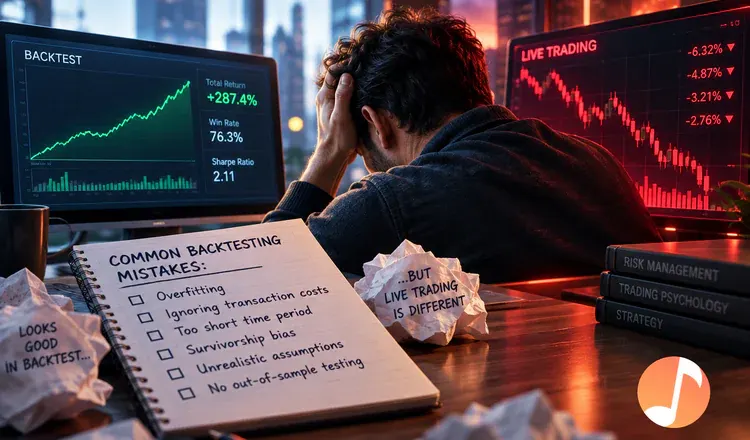
A strategy that returned 300 percent in a backtest and loses money in week one has almost never been unlucky. It was measured wrongly. Backtesting mistakes nearly all share a shape: each one quietly removes a cost or a difficulty that real trading puts back. Here are the ones that do the damage, and the single test that catches what they hide.
The mistakes that flatter the result
- No fees, no slippage. A taker fee is roughly 0.04 to 0.1 percent a side, and slippage is the gap between the price you saw and the price you got. A rule taking twenty trades a day pays that forty times a day. This alone kills most fast strategies on paper.
- Overfitting. Tuning the settings until the curve looks beautiful. If it works at 14 periods and falls apart at 13, you did not find a strategy, you found a coincidence and decorated it.
- Look-ahead bias. Using information that was not available at the time. In crypto the usual culprit is an indicator that repaints, so the test sees signals nobody could have acted on.
- One kind of market. A window covering only a rising year makes almost any buy-the-dip rule look like genius. Include a crash and a long flat stretch.
- Survivorship bias. Testing on the tokens that are still listed today. The ones that went to zero left the dataset quietly, taking their losses with them.
Why live trading is harder than the test
Three things change the moment real money is involved. Your order enters a real book, and on a thin pair it moves the price against you in a way the chart never showed - bitcoin and ether on a large exchange absorb a small order, a small token does not. Holding a position on perpetual futures costs funding every few hours, which a spot backtest never charged you. And then there is you: the test never hesitated, never widened a stop, and never skipped a signal after three losses in a row.
The test that cannot be fooled
Forward testing. Run the strategy on paper, in real time, for a month, writing down each signal as it happens. It is the dress rehearsal with the lights on, and because the future is genuinely unknown while it runs, hindsight cannot help you.
Before risking anything, rerun your best backtest with the fee field filled in honestly and the window stretched across three years. If it survives that, paper trade it for a month. The step-by-step method is in how to backtest a crypto strategy, and strategies worth putting through it are in 5 popular crypto trading strategies.