
What Is Two-Factor Authentication (2FA)?
In short
What is two-factor authentication (2FA)? The second factor explained in plain English, which kinds are strongest, and why a crypto wallet has none.
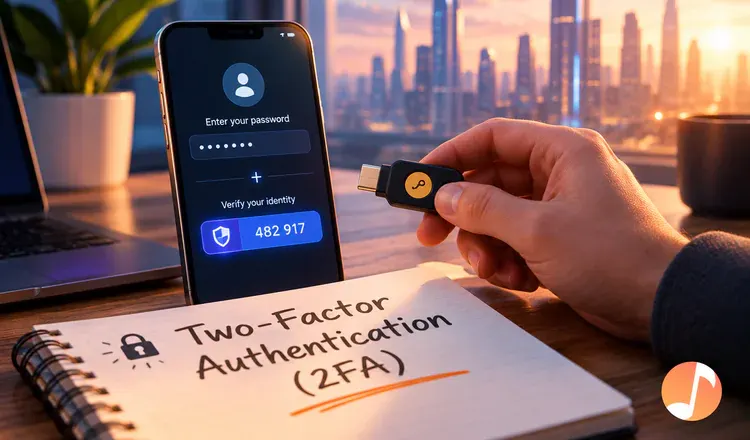
Two-factor authentication, usually shortened to 2FA, means proving who you are twice: once with something you know, and once with something you have. The password is the thing you know. The second factor — a code from an app, a tap on a small key — is the thing you have. It exists so that a stolen password on its own is worth nothing.
Why isn't a password enough?
Because passwords leak in bulk. Big sites are breached regularly, and the stolen lists are tried automatically against every other site, in case you reused one. Your bank card already works the way 2FA does and nobody finds it strange: the card is the thing you have, the PIN is the thing you know, and a thief needs both. 2FA puts that same pair in front of your email and your exchange account.
What counts as a second factor?
In rising order of strength: a code by text message, a code from an authenticator app, and a hardware security key such as a YubiKey. All three beat nothing. Text messages are the weakest, because the code follows your phone number rather than your phone, and a SIM swap moves that number to someone else in an afternoon. Exchanges including Coinbase, Binance and Kraken support app codes and keys — turn one on the day you open the account, not the day after something goes wrong.
Does 2FA protect a crypto wallet too?
No, and this catches people out. MetaMask, Phantom and a Ledger have no login to protect: no company holds your account, so there is no second factor to add. What guards a wallet is the seed phrase, plus the physical button you press on a Ledger or Trezor to approve each transaction. 2FA protects accounts at companies — exchanges, email, cloud storage. A wallet is a different problem with a different answer.
Start with your email, because every other reset code lands there, then your exchange, then anything else that can move money. Keep the backup codes each service offers on paper rather than in the same phone. Next: why an authenticator app is worth the extra step, and how SIM swaps bypass 2FA.