
What Is Repainting in TradingView and How Do I Find It and Avoid It?
In short
Repainting in TradingView explained simply: why indicators change their past signals, the three causes, and how to test any script for it in ten minutes.
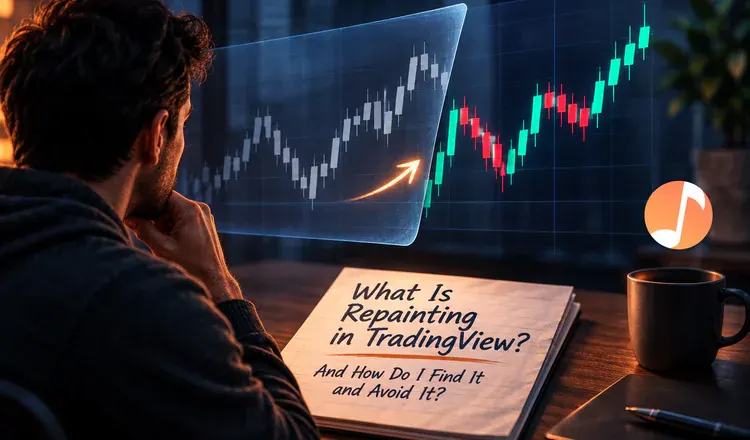
Repainting is when an indicator changes what it showed after the fact. A buy arrow appears, the candle finishes, and the arrow quietly moves, vanishes, or turns up somewhere it never was in real time. The history then looks close to perfect, because you are reading a record that was edited once the answer was known. It is the single most common reason a TradingView script looks brilliant and performs badly.
Why does it happen?
Three ordinary causes, and only one of them is anyone's fault. The first is the unfinished candle: until a candle closes its high, low and close are still moving, so anything calculated from them moves too. An RSI that dips under 30 halfway through the hour may be back above it by the close. That is not dishonesty, that is just a live chart.
The second is borrowed data. Some scripts pull a value from a higher timeframe with a setting that lets them read the finished daily candle before the day has actually finished. On a 1-hour bitcoin chart, that draws a number nobody could have known at the time. The third is the nature of the tool: anything marking pivots, zigzags or "the top" can only recognise a turning point after enough candles have passed, so it places its markers in the past by design.
How do you find it?
- Use bar replay. Rewind the chart a few weeks and step forward one candle at a time. Watch whether the signals appear where they now sit in the history.
- Screenshot and reload. Capture the last few signals, refresh the page, compare. Anything that moved, repaints.
- Read the script description. Honest authors say which parts settle only on close - and a script whose published results look flawless deserves more suspicion, not less.
How do you avoid being burned by it?
Act on closed candles only. Set alerts to fire once per bar close rather than on every tick, and judge a signal when the candle is finished rather than while it is forming. You give up a little speed and you get a signal that will still be there tomorrow.
Before trusting any new indicator, spend ten minutes putting it through bar replay - cheaper than one bad trade. The flip side of this, including why an honest script is always a candle late, is in non-repaint TradingView indicators, and the basics of the platform itself are in the TradingView tutorial for beginners.