
Zero-Knowledge Machine Learning (zkML): What It Is and Why It Matters
In short
Zero-knowledge machine learning (zkML) explained simply: proving an AI model really produced a result, without revealing the model or the data behind it.
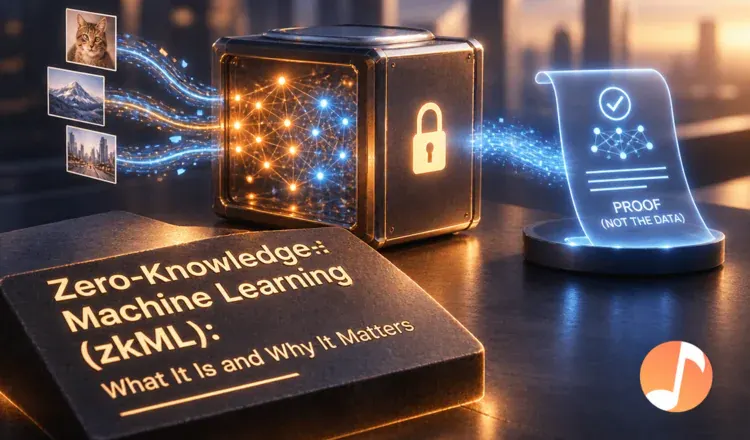
Zero-knowledge machine learning, usually shortened to zkML, means attaching a cryptographic proof to the output of an AI model. The proof shows that this exact model, run on some input, really did produce that result. It can do this while keeping the model's inner workings secret, or the input secret, or both. It answers a question that is otherwise unanswerable: did the computer actually run the thing it says it ran?
What problem does it solve?
Think of ordering a dish in a restaurant with a serious allergy. The kitchen says it followed the recipe you need. You cannot watch, and the chef will not hand over the recipe. Today you trust the kitchen. A zkML proof is the equivalent of a slip that comes with the plate and lets you verify the recipe was followed exactly, without the kitchen giving away how it cooks. Every AI service you use through an app or a website is that closed kitchen. You are told which model answered you, and you have no way to check.
How it actually works
The model's calculation is rewritten as a long chain of simple arithmetic steps, and a proof system such as a zk-SNARK produces a small file showing that chain was carried out correctly. Two limits matter. First, zkML proves the moment the model answers a question, not the months of training that produced it. Second, it is expensive: producing a proof can cost many times more computing power than the original calculation, so today's practical examples use small models, not the large chatbots. The open-source ezkl library is the usual starting point for developers.
Where crypto is trying it
Three places, all still early. Proving a trading or yield strategy on Ethereum ran as promised, so a DeFi protocol can use a model without its users trusting the operator. Proving a person is a unique human without handing over their biometrics, which is what World ID is built around. And proving an AI service gave you the model you paid for rather than a cheaper one.
There is nothing for a beginner to install here, and plenty of projects use the letters "zkML" as decoration. The useful question to ask of any of them is simple: what exactly is being proved, and who checks the proof? Start with what zero-knowledge proofs are, then see how the same proofs make exchanges more transparent.