
What Are Zero-Knowledge Proofs?
In short
What are zero-knowledge proofs? A simple explanation of how you can prove something is true without revealing the information behind it, with crypto examples.
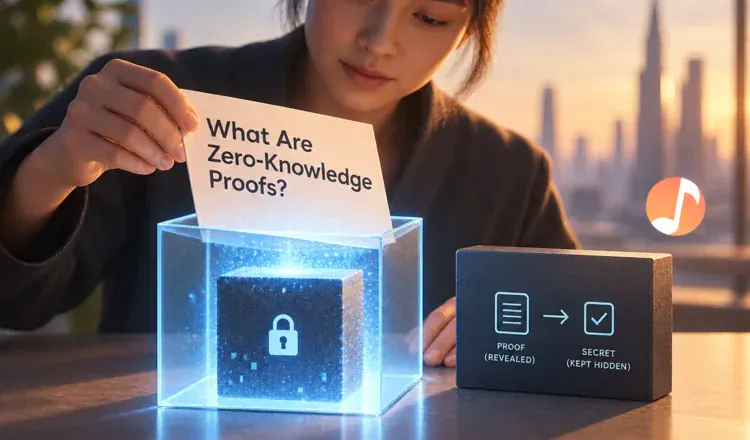
Zero-knowledge proofs let one person convince another that a statement is true without revealing why it is true. You prove you know a password without typing it, that you have enough money without showing your balance, that a transaction is valid without publishing its contents. The idea came out of academic cryptography in the 1980s and sat mostly unused until blockchains gave it an obvious job.
The picture-book explanation
Imagine a huge "find the character" puzzle page. You claim you have spotted him; a friend doubts it. Instead of pointing — which gives away the location — you cover the page with a large sheet of card that has one small hole cut in it, positioned so only the character shows through. Your friend sees him clearly and learns nothing about where on the page he sits. That is the whole trick: reveal proof of the fact, not the fact's details.
Three things every such proof must do
Cryptographers ask for three properties, and the plain versions are short. If the statement is true, an honest prover can always convince the checker. If it is false, a liar will be caught, except with a vanishingly small probability. And the checker finishes knowing only one thing: true or false. Drop any one of those and it stops being a zero-knowledge proof.
Where you meet them in crypto
Zcash uses them to settle payments where the sender, receiver and amount are hidden but the network can still confirm no money was conjured up. Ethereum rollups like zkSync Era, Scroll and Starknet use them to compress thousands of transactions into one proof, cutting fees sharply. Outside crypto, the same maths is being used for identity: proving you are over a certain age, or a resident of a country, without handing over the document itself.
There is nothing to install and nothing to learn to benefit from this — if you use a zk rollup, you are already relying on it. The practical habit worth keeping is scepticism about the word "private": many products use these proofs for speed, not secrecy, and will say so if you read the documentation. Next, see how a zero-knowledge proof actually works and what it changes for blockchains.