
Stablecoin Regulation in 2026: MiCA, the GENIUS Act, Brazil and Japan
In short
Stablecoin regulation in 2026: where MiCA, the GENIUS Act, Brazil's authorisation regime and Japan's issuer rules stand, and what each means for holders.
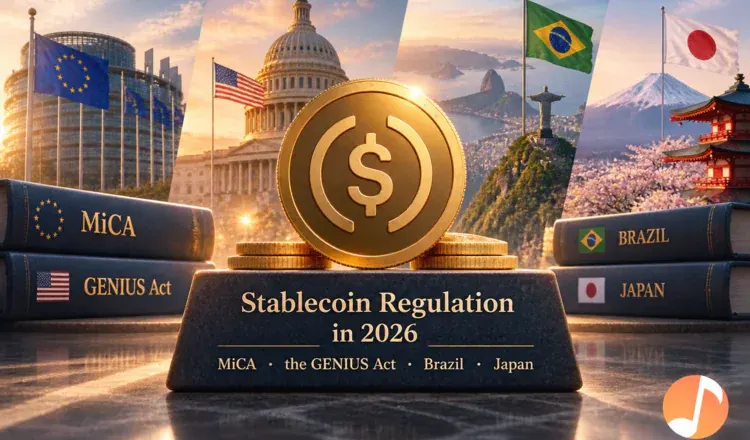
By 2026 the four markets that matter most for stablecoins all have real rules. Europe's MiCA is fully applied, the United States has the GENIUS Act with an effective date of 18 January 2027, Brazil's authorisation regime started on 2 February 2026, and Japan has regulated stablecoins since 2023. The rules were written separately and landed in nearly the same place: full backing, redemption at face value, and a licensed company behind the token.
Europe and the United States
MiCA has applied to stablecoins since 30 June 2024, and the last transition period for crypto service providers ended on 1 July 2026. Only licensed banks and electronic money institutions may issue a euro or dollar token in the EU. The visible result: Circle took a licence in France and issues USDC there, while Tether did not seek authorisation and USDT was dropped by most EU-regulated exchanges for European customers. The US law works toward the same shape on a later clock — issuers approved from January 2027, and from 18 July 2028 service providers may no longer sell non-approved stablecoins to people in the US.
Brazil and Japan
Brazil built its framework on a 2022 law and three central bank resolutions that took effect on 2 February 2026: companies providing crypto services there must be authorised by the central bank, with a transition window for those already trading. Stablecoins matter unusually much in Brazil because payouts feed into Pix, the instant payment system most Brazilians use daily, so a dollar token can become local money in seconds. Japan went first of all: since its revised Payment Services Act took effect in 2023, a yen stablecoin counts as an electronic payment instrument, only banks, trust companies and registered money transfer agents may issue one, and redemption at face value must be guaranteed.
What is still unsettled
Mainly two questions. How regulators will treat yield-bearing tokens that look like payment balances but sit outside these definitions. And how a stablecoin issued in one country reaches customers in another, which both the EU and the US are still working out.
For a holder, the practical takeaway is that where your exchange is licensed now decides which stablecoins it can offer you, and that list is still changing. Check which tokens your platform supports before you plan around one. Next: the GENIUS Act and MiCA side by side, or what the GENIUS Act asks of issuers.