
What Are Order Books and Liquidity?
In short
Order books and liquidity explained simply: what the book lists, what liquidity measures, and why a thin market costs you most on the way out.
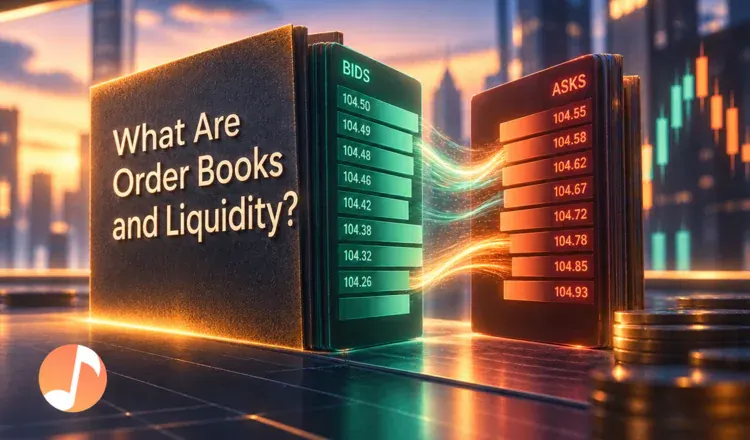
An order book is the list of every buy and sell offer waiting on an exchange for one pair — bitcoin against dollars, say. Liquidity is how much of that offer sits close to the current price: how much you could trade right now without shoving the price against yourself. One is the thing, the other is the measure of how full it is.
Why the two words always turn up together
Think of a taxi rank. The rank is the order book — drivers lined up, each willing to take you somewhere for the meter. Liquidity is how many cabs are waiting. At a busy station at noon you step into the first one and pay the normal fare. At three in the morning there is one driver left, and he names his price. Markets work the same way: the book tells you who is offering what, and liquidity tells you whether taking those offers will cost you anything extra.
Liquidity is not the same everywhere
It belongs to a pair on a venue, not to a coin. Bitcoin against USDT on Coinbase or Kraken is about as liquid as crypto gets — millions of dollars sit within a hair of the price. The same bitcoin on a small exchange, against a minor currency, can be thousands of times thinner. Decentralised exchanges such as Uniswap have no book at all: liquidity there is a shared pot of two tokens that people have deposited, and a formula quotes your price against it. Different machinery, same question — how much is there to trade against?
What thin liquidity does to you
Getting in is rarely the problem. Getting out is. A token you can buy $500 of without moving the price may be impossible to sell $5,000 of at anything like the quoted rate, because the bids underneath it simply are not there. This is also how many small-token scams work: the chart looks healthy, the reported volume looks real, and then nobody is on the other side when you try to leave.
Before buying anything outside the big coins, look at the book and ask what selling your whole position would fetch — not what buying it costs. If that answer makes you uncomfortable, size down. For the mechanics, read how an order book works and what order book depth measures.