
What Is an OCO (One-Cancels-the-Other) Order?
In short
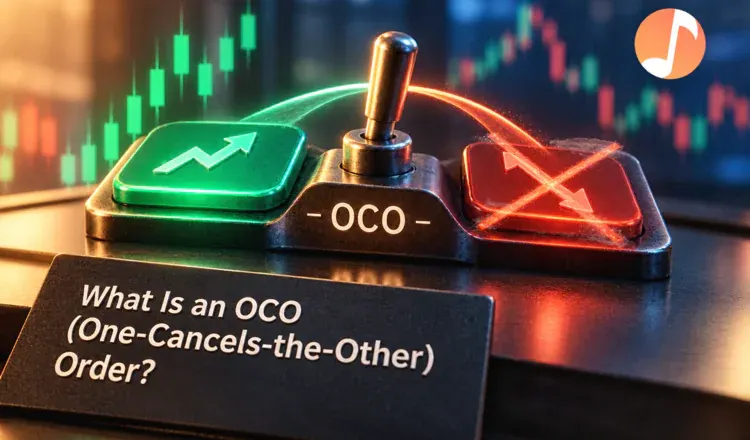
An OCO (one-cancels-the-other) order pairs a take-profit and a stop in one instruction: whichever fills first, the exchange cancels the other.
An OCO order — short for one-cancels-the-other — is two orders placed as a single instruction, with a rule attached: whichever one executes first, the exchange cancels the other automatically. In practice it is a take-profit above the current price and a stop below it, wrapped around a position you already hold. You set both ends of the trade once and stop watching the screen.
Why would you need two orders at once?
Say you bought ether at $2,000. You would happily sell at $2,400, and you do not want to lose more than about $200 if you were wrong. Those are two exit orders on opposite sides of the market, and only one of them should ever fill. Place them separately and you have a problem: if the stop fills overnight, your sell order at $2,400 is still sitting there, attached to ether you no longer own. An OCO ties the pair together so that cannot happen. Think of the two exits in a building — you leave by one door or the other, and opening one locks the other behind you.
How you place one
On Binance's spot market the OCO panel asks for three numbers, and most other venues — Coinbase Advanced, Kraken — offer the same thing, sometimes labelled a bracket.
- Limit price. Above the market if you are selling. This is the happy exit.
- Stop price. Below the market. Touching it wakes the second order up.
- Stop-limit price. A little below the stop, so a fast drop still finds a buyer.
Binance also has OTO and OTOCO orders, where an entry order triggers the pair for you once it fills — useful when you are not in the trade yet.
What an OCO cannot do
It does not improve either exit; it only guarantees you do not end up with both. The stop half carries the usual stop-limit risk, so if the market gaps straight through your trigger, the limit order it places can sit unfilled. And while the OCO is live, most exchanges reserve the coins, so you cannot spend them elsewhere.
Place your first one for a small amount with deliberately wide prices, then cancel it, just to see which field is which before real money depends on it. Stop-limit order: definition and example works through the two prices in the stop half, and the order types on Binance shows where OCO sits in the panel.