
Stop-Limit Order: Definition and Example
In short
Stop-limit order definition and example: what the stop price and limit price each do, how the two differ, and when the order fails to fill.
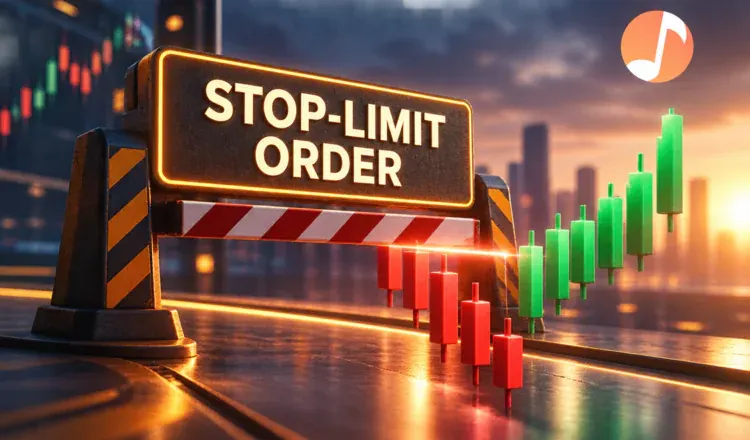
A stop-limit order is an instruction that does nothing until the market reaches a price you choose, and then places an ordinary limit order on your behalf. It has two numbers, and the whole definition hangs on the difference between them: the stop price is the trigger that wakes the order up, and the limit price is the worst price you will accept once it is awake. It is the standard way to arrange a stop-loss on Binance, Coinbase and most other exchanges.
A worked example
Suppose you hold one ether that you bought at $2,000, and you have decided you do not want to lose more than about a tenth of that. You set a stop-limit to sell: stop price $1,800, limit price $1,780. Nothing happens while ether trades above $1,800 — the order is invisible to the market. The moment it trades at $1,800, the exchange places a sell limit order at $1,780, and it fills as long as someone is buying at $1,780 or better. The $20 gap is deliberate breathing room.
Why the two prices must differ
Because a falling market does not stop politely at your number. If you set both prices at $1,800, the market can drop through $1,800 in one tick, your limit order is placed at $1,800, nobody is buying there any more, and you are left holding the position with an unfilled order. That is the single most common failure, and the fix is simply to leave a sensible gap — wider for a volatile token, narrower for a deep pair like BTC/USDT.
What it cannot protect you from
A gap. If news breaks and the price jumps from $1,850 to $1,600 with nothing traded in between, your stop triggers and your limit order sits below the market, unfilled. A stop-limit protects your price, not your exit. If being out matters more than the price you get, a plain stop-market order is the honest choice, at the cost of a worse fill.
Before you rely on one, place a small stop-limit well away from the current price and cancel it, just to see where the two fields are and how the exchange labels them. How to trade with limit, market, stop-limit and bracket orders shows how it fits with the rest, and the Binance order types covers the OCO version that pairs it with a take-profit.