
Long Short Ratio: What It Says About Crypto Sentiment
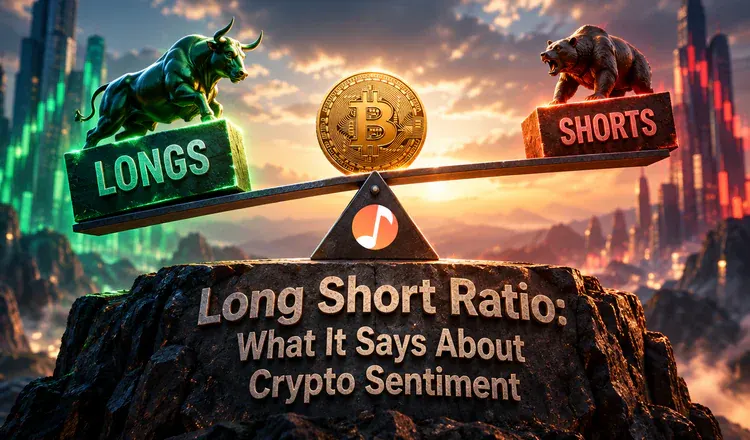
The long short ratio compares how much of an exchange's futures market is positioned for the price to rise against how much is positioned for it to fall. Above 1 means the long side is larger, below 1 means the short side is. As a sentiment gauge it is useful, but it measures something narrower than "how the market feels" - and the gap between those two things is where most beginners get caught.
Sentiment, or just positioning?
Futures are a closed room: every long is matched by a short, so the ratio never shows more buyers than sellers. What it shows is distribution - whether one side is held by a great many accounts or by a few large ones. That is why exchanges publish several versions of the number. One counts accounts, one counts position size, one narrows it to the biggest traders on the venue. A thousand small accounts leaning long can sit opposite a handful of very large shorts, so the account version can read bullish while the size version reads the opposite. Check which chart you have before drawing any conclusion.
Why extremes are read backwards
When a large majority of accounts pile onto one side, a great many similar stop-losses end up sitting in a similar place. Markets have a habit of running through clusters like that. So an unusually lopsided ratio is generally treated as a reason for caution about joining the crowd, not as confirmation that the crowd is right. It is the crypto version of a crowded lifeboat: everyone standing on the same edge is the problem, regardless of which edge.
What it cannot see
It covers one exchange, not the market. It ignores spot entirely - the person who bought ether on Coinbase and moved it to a MetaMask wallet is invisible in it. And it says nothing about timing; a crowded reading can stay crowded for weeks while the price does nothing at all. Treat it as one gauge among several rather than a signal on its own.
If you want to learn its rhythm, pick one pair, note where the ratio reached its extremes over the past year, and look at what happened in the week after each one before you let it influence a trade. The bitcoin version is covered in the bitcoin long short ratio, and the size of the crowd behind it in open interest.