
Market Order vs Limit Order in Crypto: When to Use Each
In short
Market order vs limit order in crypto: what each does to your money, why the fill price can surprise you, and when to use each one.
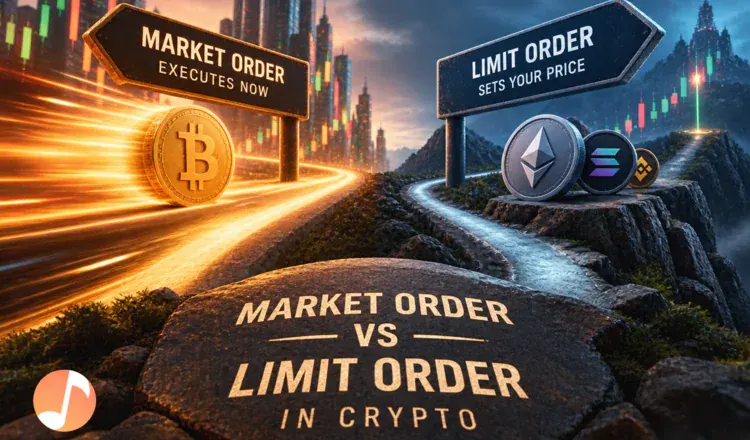
A market order buys or sells straight away at whatever price the market is offering right now. A limit order names the price you are willing to accept and waits — it fills only if the market comes to you, and sometimes it never does. That is the whole difference between a market order and a limit order in crypto: one guarantees that the trade happens, the other guarantees the price. You cannot have both.
What each one does to your money
Every exchange keeps an order book: a live list of what buyers will pay and what sellers will take. A market order walks into that list and grabs the best prices available until it is filled. On a busy pair like BTC/USDT on Binance that costs you almost nothing extra. On a quiet pair it can sweep through several price levels and finish well above the number you saw on screen. A limit order does the opposite. It joins the book at your price and sits there, visible to everyone, until someone trades against it or you cancel.
When should you use a market order?
Whenever getting in or out matters more than a fraction of a percent. Your first small purchase of bitcoin on Coinbase is a fine market order: the pair is deep, the spread is tiny, and arguing over a few cents is not worth the effort. Closing a position you have already decided to exit is another. It is the wrong tool for a thinly traded token, and a bad habit in a violently moving market, where the price you tapped is not the price you get.
When should you use a limit order?
When you have a number in mind and can live with not being filled. Buying a dip you are not sure will arrive, selling into strength while you sleep, or trading anything with a wide spread all call for a limit order. There is a second reason, too: most exchanges charge less for an order that waits in the book (a maker order) than for one that takes liquidity out of it (a taker order), so patience is often cheaper by a few basis points.
The habit worth building is to default to limit orders and reach for a market order only when speed genuinely matters. If you want the price protection of a limit order to kick in automatically after a move, read about the stop-limit order, and the order types available on Binance shows what else the panel offers.