
Market vs Limit vs Stop Orders in Crypto, With Examples
In short
Market vs limit vs stop orders in crypto, with examples: what each one does to your money, what it costs and when to reach for it.
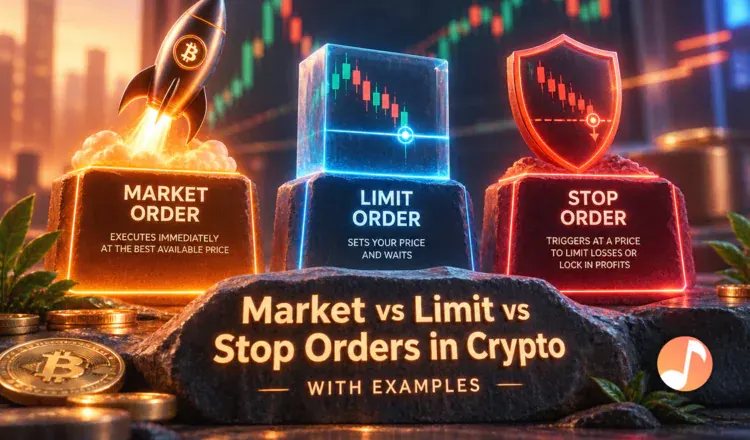
Three orders cover almost everything a beginner needs. A market order buys or sells right now at whatever price is available. A limit order names your price and waits for the market to come to it. A stop order sits dormant until the price touches a trigger you set, and only then becomes a live order. The first is about speed, the second about price, the third about protection.
Market and limit, with examples
You want $500 of bitcoin on Coinbase and bitcoin is trading at $60,000. A market order fills in a second: the exchange takes the cheapest coins on offer until your $500 is spent. On a deep pair like BTC/USD that costs you a few dollars at most. Now try the same with a small token on a quiet exchange — the cheapest offers run out after $100, and your remaining $400 buys at steadily worse prices. That invisible cost is slippage, and it is why a limit order exists: set it at $59,800 and you either get that price or nothing. The trade-off is plain. Market orders always execute but not always at a good price; limit orders always get a good price but do not always execute.
Stop orders, with an example
You hold ether bought at $2,000 and you have decided a drop to $1,800 means your idea was wrong. A stop order placed at $1,800 does nothing at all while ether trades above it — it is not in the order book and nobody can see it. The moment ether trades at $1,800 the order wakes up and sells. A stop-market sells at whatever is there, so you get out but perhaps at $1,790. A stop-limit places a limit order instead, which protects your price but can leave you unfilled if the market drops straight past it.
Which to use when
Buying a major coin for the long term: market is fine. Buying anything thinly traded, or buying a large amount: limit. Protecting a position you cannot watch: stop. The usual beginner mistake is using market orders everywhere and quietly paying a percent each time.
Place a limit order far from the current price and watch it sit in the book for a minute before cancelling — seeing it wait is what makes the difference click. Market order vs limit order: when to use each goes deeper on the first pair, and stop-limit order: definition and example works through the two stop prices with numbers.