
How to Read Liquidity and Order Book Depth
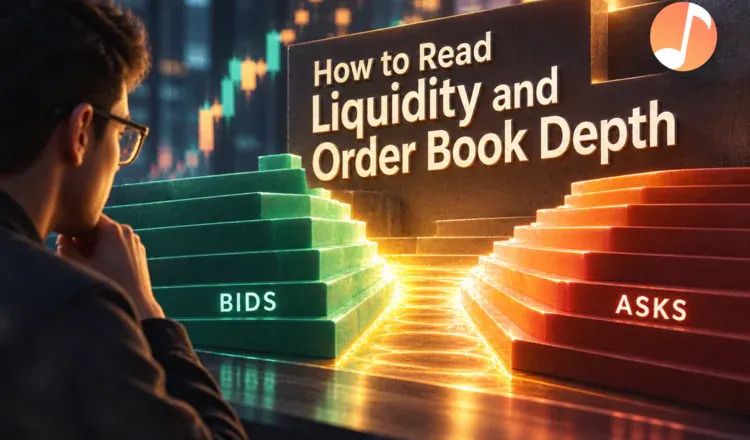
In short
How to read liquidity and order book depth before you trade: sizing your order, spotting a thin market, and ignoring walls that are not real.
Reading liquidity means asking one question before you trade: if I send this order right now, how much will I move the price against myself? The order book answers it. Add up what is on offer between the current price and the worst price you would accept — if your order is bigger than that, you are the one moving the market.
Size your order against the book, not your balance
This is the habit that separates an expensive fill from a cheap one. Before buying, count the asks within half a percent of the price. If there is $200,000 on offer and you want $5,000 of it, you are a minnow and a market order is fine. If you want $150,000, you are most of the book and should work the order in pieces. On bitcoin almost everyone is a minnow; on a small token, a $2,000 order can be the whole first page.
Two sides, rarely equal
Bids and asks are seldom balanced, and the lopsidedness is the interesting part. A book with heavy bids and thin asks tells you a push upward will be cheap and a drop will be cushioned — for as long as those orders stay there, which may be seconds. Treat it as a description of the market right now, not a forecast of the next hour.
Why that big wall may be fake
A huge order parked a little away from the price looks like a solid floor or ceiling. Sometimes it is. Often it is bait, placed to make others act and cancelled before it can be hit — the practice is called spoofing, and it is banned on regulated venues but still common on smaller ones. The test is simple: real walls get eaten into when the price arrives, fake ones disappear just before. Never let a wall alone set your stop.
Try this once with real numbers: pick a token, decide the amount you would buy, and add up the asks it would consume. The number will probably surprise you. For the groundwork, see what order book depth is and how the spread and slippage turn into cost.