
B3 and Six Brazilian Institutions Target Open BRL for Early 2027
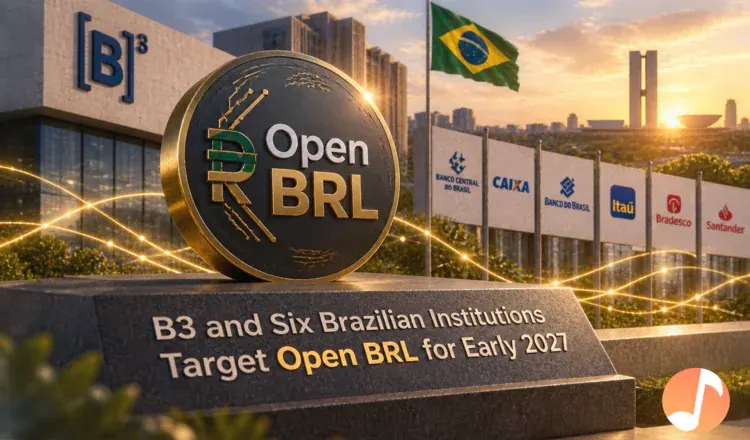
Brazil's exchange operator B3 will issue a stablecoin pegged to the real, with six of the country's largest financial institutions behind it. The token is called Open BRL and the group is aiming at the first quarter of 2027. Banco B3, the exchange's banking arm, is the issuer, and each unit is backed by one real in reserve. Bradesco, BTG Pactual, Itaú Unibanco, Safra, Santander and XP are the partners. Both accounts read here trace it to a Friday report by the local outlet Valor Econômico.
Two accounts, one quarter, opposite leads
CoinDesk and Cointelegraph published within two hours of each other on Friday and chose opposite angles. CoinDesk treats the plan as a launch and gives no earlier date. Cointelegraph treats the same report as a delay, noting that B3 first disclosed stablecoin plans in December 2025 with a 2026 launch in mind. The two agree on the quarter, the six names, the issuer and the one-to-one backing. What separates them is what each put first.
The Cointelegraph account also raises something CoinDesk's does not. As recently as July the exchange was preparing a different real-backed token, B3RL, secured by government bonds, with integration testing set for August and September. Whether Open BRL replaces B3RL or runs beside it is unclear on that account, which says B3 had not answered by publication. Neither piece settles it.
Why rival banks would share one token
The design answers a problem the partners say they hit. Talks began about three months ago, after B3 and the banks concluded that a stablecoin issued by any one of them could face pushback from the rest, on CoinDesk's account. Each bank keeps its own internal token under the plan, and Open BRL is the neutral unit they move between themselves through the exchange. Other institutions can join from the first day. Luiz Masagão, B3's vice president of products, is the executive quoted in the Valor report.
"Our goal is for this initiative to be open to the entire Brazilian financial market," Masagão said.
B3 will run the technology at launch while a steering committee sets governance, operating rules, technical standards and pricing. The partners are funding the venture and have not disclosed how much. Once the network grows they may spin it off into a separate company, Masagão said. He also said the group is working inside existing rules, has briefed the central bank, and has the securities regulator's backing because the project ties into tokenization. All of that rests on a single account.
A thin slice in local currency
Real-pegged tokens are a small corner of a large crypto market. Brazilians declared 404.8 billion reais in stablecoin trades in 2025, about 80 percent of all reported crypto activity, on figures CoinDesk attributes to the tax authority Receita Federal. USDT, the dollar token, drove nearly 90 percent of that volume on the same account. Three measures of local-currency supply appear in that piece, and each counts something different. The consultancy Fintrender put total supply above $140 million across more than 10 tokens in May; the data firm DIA shows about $71 million in verified onchain supply across five publicly tracked coins, led by Avenia's BRLA and Transfero's BRZ. One of those tokens, BRL1, has a $3.4 million market value on DefiLlama. Outside money has been moving towards local-currency issuers as well, with Tether Capital backing stablecoin projects across Asia and MENA.
What has to happen before the quarter arrives
Nothing published says which blockchain the token runs on, what day in the quarter it arrives, or how much the six are spending. The licensing position is firmer. Brazil's central bank rules, in force since February, require platforms to hold a licence and treat stablecoin trades as foreign exchange operations, and no separate regime exists yet for local stablecoin issuers. Registration has been slow going, and the country's filing deadline passed with no firm yet licensed. B3 says it is building inside the current rules — a claim about the framework in force now, not about the one that may govern Open BRL in 2027.
Read also: Binance Files for a Brazil Licence Before the 30 October Deadline