
Sentiment Analysis in Crypto Trading: A Guide for Beginners
In short
Sentiment analysis in crypto trading, explained for beginners: what gets measured, which free tools to start with, and the mistakes that cost people money.
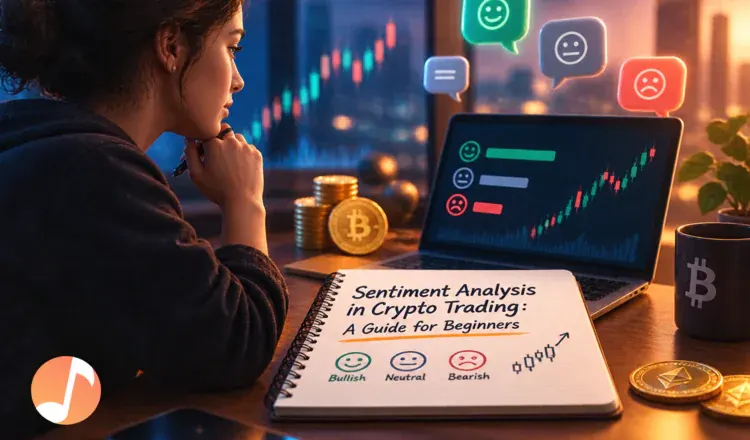
Sentiment analysis in crypto trading means measuring how the crowd feels instead of what a project does. You collect evidence of mood — posts, search interest, how traders are positioned — and ask one question: is this trade crowded or lonely? It is a third way of looking at a market, alongside reading charts and reading a project's fundamentals, and it is the one beginners most often do badly.
What actually gets measured
Three families of data, in rising order of reliability:
- Talk. How many posts mention a coin, and whether software reading them scores the wording as positive or negative. Santiment and LunarCrush sell this; the fear and greed index on alternative.me bundles a simplified version into one free daily score.
- Searching. Google Trends for "buy bitcoin", or where an exchange app sits in the app store charts. Both rise when newcomers arrive.
- Money at risk. Funding rates and long-short ratios on futures, published by exchanges such as Binance and Bybit. People lie in posts; they are more honest with their own capital.
Reading it the right way round
Sentiment is usually read against the crowd, not with it. Picture a restaurant with a queue around the block: the food may be good, but you are not getting a table tonight. A coin everyone is talking about has already attracted the buyers who were going to buy, so there is less fuel left for the move to continue. Quiet coins have the opposite problem and the opposite potential.
Crucially, this is about odds, not certainty. Extreme greed can last for months, and plenty of crowded trades keep running. Nobody can tell you where the price is going.
The beginner mistakes
Three come up constantly. Treating a sentiment reading as an entry signal, when it is background context. Watching one measure alone, when any single one can be gamed — social counts especially, since bots post too. And confusing news with sentiment: a headline is an event, while sentiment is how many people reacted and how loudly.
A reasonable first month: open the free fear and greed index and your exchange's funding page, note both down daily next to what you felt like doing, and change nothing. The log will show you how often your own instincts match the crowd's, which is the actual lesson. Then go deeper with reading the fear and greed index and social volume.