
LayerZero Adds Kakao Pay and Samsung Card as Zero Validators
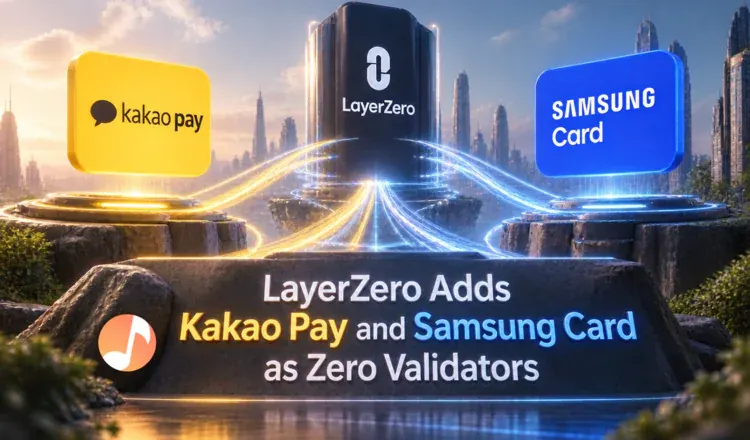
LayerZero named three Asian companies on Wednesday as genesis validators for Zero, the Layer 1 blockchain it has scheduled to go live on 30 November. Kakao Pay, Samsung Card and ZAN, a node operator backed by Ant Digital Technologies, join a validator set that already holds operators in Europe and North America. Four Pillars, a South Korean blockchain research firm, will run the node on Samsung Card's behalf. None of the three has committed to a product on the chain. What they have agreed to do is verify proofs.
What a Zero validator actually does
Zero splits the work most blockchains duplicate. Block producers execute transactions and generate a zero-knowledge proof of the result, a cryptographic receipt that can be checked without redoing the computation. Validators check the proof and stop there. LayerZero says that strips out a layer of redundancy, because the set never re-executes every transaction in order to agree on it.
ZRO staking opened on 23 November. Until 31 March 2027 staked ZRO is spread equally across the genesis validators instead of being assigned to one operator, and voting weight depends on how much ZRO sits behind each participant. That arrangement sets the opening security of a chain which has not produced a block yet.
Two consumer franchises, one infrastructure bet
Kakao Pay has roughly 26 million monthly active users and processed more than $100 billion in transaction volume during 2025, on figures LayerZero supplied. Samsung Card had about 13.92 million cardholders at the end of September, a count that appears in The Block's write-up and not in the other account read here. ZAN provides node services and zero-knowledge acceleration across more than 80 networks, again on LayerZero's own number. None of those figures was verified independently here.
Kakao Pay's chief executive, Shin Won-keun, said the company would look at Zero's part in a won-pegged stablecoin ecosystem. That is an intention. The announcement names no token, no date and no commercial deployment. Won stablecoin plumbing has been going in elsewhere this year, including Injective's decision to make BDACS's KRW1 its only won settlement asset.
The pitch and the pilot numbers
"The future of global markets needs Better Markets Technology: infrastructure that matches not only the speed and borderless nature of tokenized assets, but the structural resilience of globally distributed ecosystems," Pellegrino said.
Bryan Pellegrino, LayerZero's co-founder and chief executive, has said the Asian additions are meant to give Zero a globally distributed validator set at launch. Zero itself was announced in February with collaborations involving Citadel Securities, DTCC and Intercontinental Exchange, and a strategic investment from ARK Invest. It arrives alongside ATLAS, a trading engine meant to let financial platforms run their own venues with continuous trading, instant settlement and onchain trade verification. LayerZero says the lzATLAS infrastructure launches with capacity above 250,000 transactions per second, a company figure with no live performance behind it.
One test is on the record. A pilot with the German venue 21X, announced on 4 November, ran 21X's live central limit order book on a private, permissioned Zero deployment and reported 10,000 order matches per second, up to 45 times the EVM benchmark LayerZero used. That was a controlled run on a permissioned deployment and not a public mainnet.
What sits behind the new chain
LayerZero's existing business is cross-chain messaging, and that business had a bad year. An exploit in April on a LayerZero-based bridge serving KelpDAO took about $292 million in rsETH, and the company's postmortem described compromised infrastructure and a single-verifier configuration that let a forged cross-chain message through. Kelp's operator sued LayerZero Labs and its chief executive in Vancouver in September, and the allegations are untested. None of that touched Zero, which was not a live network at the time.
Whether Wednesday's three names turn into volume is a question for December. Samsung Card's node is being operated by somebody else, Kakao Pay has described an intention, and ZAN sells node services for a living. The chain and ATLAS go live on 30 November, and the validator set is the first part of the claim anyone outside the company will be able to check.
Read also: LayerZero Ends Offchain Service for 13 Chains on 30 September