
Judge Acquits the Peraire-Bueno Brothers in the $25M MEV Case
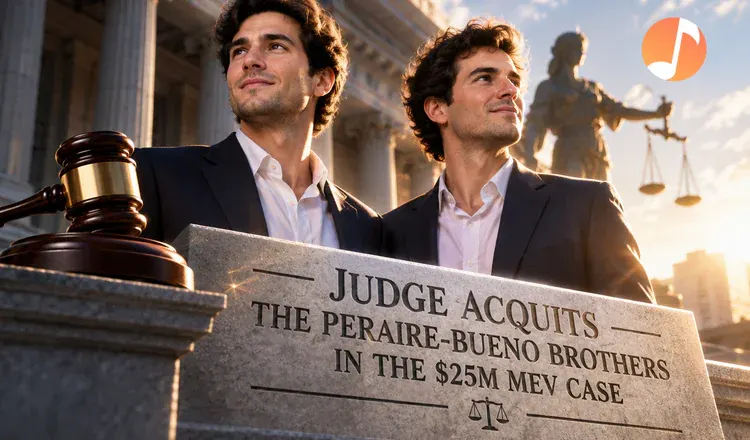
Two brothers accused of taking $25 million from Ethereum trading bots in April 2023 will not be tried a second time. Judge Jessica Clarke acquitted Anton and James Peraire-Bueno in Manhattan federal court on Monday, granting their motion for a judgment of acquittal. A jury had deadlocked in the first trial a year earlier. Prosecutors charged the pair with wire fraud and related counts in a case its indictment called first of its kind, and Clarke held that none of the government's theories established the material misrepresentation that wire fraud requires. Decrypt, reporting on Tuesday morning, said the ruling closes the case without a retrial.
What a trustless network does to a fraud charge
The brothers, both educated at MIT, were accused of baiting bots that run a strategy called sandwiching, in which a bot places its own orders on either side of someone else's trade to profit from the price move it causes. Clarke's reasoning starts from where that trade happens. She described Ethereum as a "trustless, highly adversarial environment with no terms of use", on Decrypt's account of the ruling, and found that the scheme "may have frustrated the spirit" of MEV-Boost, the software validators use to outsource the assembly of blocks, without anyone making a statement that was false. Cointelegraph reached the same place in different words: the transactions were not false promises and did not amount to criminal fraud. Bots of this kind have been emptied by far cruder means, among them a leaked token approval in June.
"The question before the Court is not whether the Peraire-Buenos' conduct was right or moral," Clarke wrote, in the passage Decrypt quoted from the ruling.
Twelve seconds, and two accounts of what broke
Both outlets put the take at $25 million in about 12 seconds. They do not agree on the flaw. Decrypt says the brothers exploited a bug in a relay's code, which let them see the bots' bundled trades before committing to a block; Cointelegraph says the flaw sat in MEV-boost software itself. A relay and that software are separate components, and the two descriptions do not reconcile. Neither piece gives a block count. Decrypt alone describes what followed the bait: the brothers swapped their own transactions for trades that sold the tokens instead, and prosecutors said they had spent months preparing and moved to conceal the proceeds. That account stands on one outlet.
A year between the deadlock and the ruling
The exploit dates to April 2023. Decrypt puts the arrest in May 2024, the first trial in Manhattan in 2025 and the mistrial in November 2025, after jurors failed to agree; neither outlet reports how the jury split. Decrypt names three counts, wire fraud, conspiracy to commit wire fraud and conspiracy to commit money laundering, with the laundering count falling because it rested on proceeds the fraud counts no longer supported. Cointelegraph says only "wire fraud and related charges". Wire fraud is the statute the government reaches for in most of its crypto prosecutions, including the FTX case whose $11 billion forfeiture reached the Supreme Court in September. Here it did not hold.
Nobody has said whether this is the end
Neither account states whether the government may appeal, and we could not establish it. Cointelegraph carries reaction from Peter Van Valkenburgh of Coin Center, who called the acquittal "excellent news" and argued that the prosecution's theory of an honest validator would have let the government set its own standard for conduct on Ethereum; no other outlet this desk read carries that comment. The same piece says the ruling cites a 2025 decision involving the Mango Markets trader Avraham Eisenberg, which also found insufficient evidence of false representations. That citation is likewise single-sourced. Decrypt reports a footnote in which Clarke noted the prosecution "raises serious due process concerns" and declined to rule on them. A footnote left undecided is not a precedent. What the ruling settles is narrower than the headline suggests: on this record, in this court, taking $25 million out of a bot was not a lie.
Read also: Judge Refuses to Undo Gemini's $5M CFTC Settlement Despite Joint Motion