
Supreme Court Declines Custodia's Fed Master Account Appeal
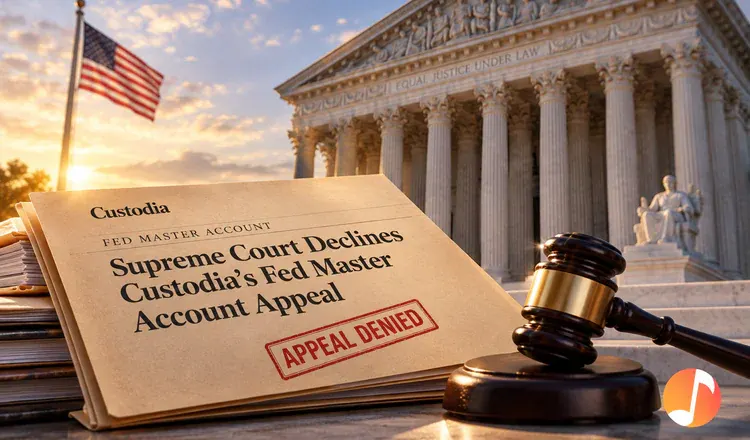
The Supreme Court turned down Custodia Bank's challenge to the Federal Reserve on Monday. The case sits on the court's order list for 16 November as "26-62 CUSTODIA BANK, INC. V. FED. RESERVE BD., ET AL.", one line in the column headed certiorari denied. No opinion came with it. The denial leaves standing a Tenth Circuit ruling that regional Reserve Banks may refuse a master account to an institution the statutes make eligible for one, and it closes the last court Custodia had left.
What the court did not decide
A denial of certiorari is not a ruling on the merits. The justices did not hold that a crypto-focused bank is unfit for the payment system, and did not endorse the Kansas City Fed's reasoning. They declined to review a reading of two statutes. That reading binds inside the Tenth Circuit and is the working answer elsewhere until another appeals court disagrees. A master account is the account a bank holds at a Reserve Bank, and the way into Fedwire and the Fed's other services; without one, a bank settles dollars through a correspondent that has one. All three accounts this desk checked define it the same way.
Two provisions, pulling opposite ways
Custodia's case rested on the Monetary Control Act, which says Federal Reserve services "shall be available" to nonmember depository institutions. The Tenth Circuit read that clause as a pricing instruction addressed to the Board, and put the authority to open an account in Section 342 of the Federal Reserve Act, which says a Reserve Bank "may receive" deposits. May is discretionary. Bitcoin Magazine, filing Monday, traces that two-provision split to the October 2025 opinion; BlockchainReporter gives the same split. That outlet also reads the 2022 transparency amendment, codified at Section 11C, as the majority's strongest evidence: a database recording rejected applications presumes rejections are permitted. No other account this desk read makes that argument.
"We are bound by the ordinary language of the statute and, in my view, shall means shall," Judge Tymkovich wrote in dissent.
Six years from application to one-line order
Custodia applied to the Federal Reserve Bank of Kansas City in October 2020. In January 2021 the Reserve Bank confirmed the applicant was legally eligible and told it there were "no showstoppers". On 27 January 2023 the same bank denied the account, calling the business model "unprecedented" and "narrowly focused on crypto-asset activities", and the risks "highly likely" to be "inconsistent with safe and sound banking practices" without federal supervision. The Board denied Custodia's membership application, filed in August 2021, the same day. A district court granted the Reserve Bank summary judgment in March 2024, the Tenth Circuit affirmed 2-1 in October 2025, the full court declined to rehear the case in March, and the petition reached the Supreme Court in July. Published accounts round the fight's length differently, so count from the application: six years and one month.
Where the next applicant goes
The charter was never the obstacle. Custodia is a Wyoming special purpose depository institution: it takes dollar deposits, holds digital assets in custody, cannot lend, and must keep liquid assets against every deposited dollar. Kraken's banking arm, on the same Wyoming charter and full-reserve model, was granted a master account in March. The Block reported that approval on Monday as the first for a crypto company; BlockchainReporter attributes the word first to the company's own announcement. This desk logged that claim in September as single-sourced; a second outlet now carries it. Discretion is what the two outcomes have in common. The Fed has meanwhile floated a slimmed-down account that would pay no interest and offer no discount-window access. Custodia told the court that version would not serve. The other door is a federal charter, which is the route one stablecoin issuer took to the OCC. Neither guarantees a line into the payment rails. Custodia did not respond to a request for comment from The Block, and neither the bank nor its chief executive, Caitlin Long, had spoken publicly when Bitcoin Magazine filed on Monday morning. What the bank does next is the only part of this still open.
Read also: Community Bankers Sue the OCC to Vacate Its Trust Charter Rule