
Petrobras Tests Two Cardano Apps for Jet Fuel and Diesel Tracking
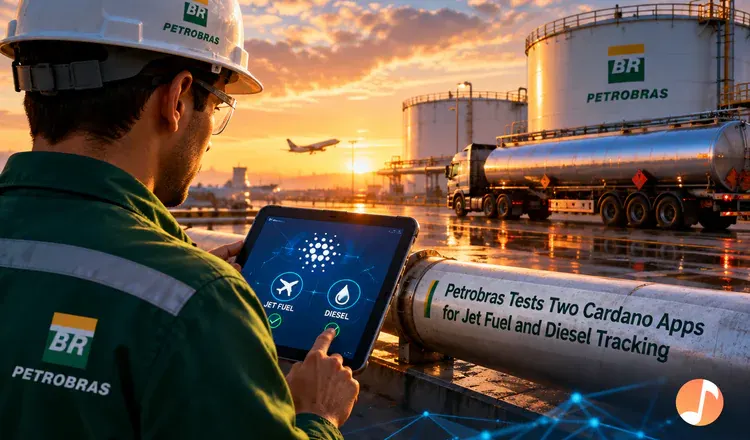
Petrobras, Brazil's state-controlled oil company, has built two applications on Cardano with the Cardano Foundation and researchers at PUC-Rio's Ledger Labs. One turns the environmental attribute of sustainable aviation fuel into a digital record that can be sold on its own. The other writes checkpoints across the production, transport and use of the company's renewable diesel. Neither is in commercial use. All four accounts read here call the work research and development, and none attaches a date to anything past that stage.
What a book-and-claim record actually holds
The aviation application runs on a book-and-claim model, a market convention that separates the environmental benefit of a batch of fuel from the fuel itself, so an airline can buy the benefit without taking delivery of the litres. What goes on chain is the origin of that benefit, who it was allocated to and whether it has been claimed. The metadata is aligned to CORSIA, the aviation industry's carbon offsetting and reduction scheme, which is the framework an airline reports against. The accounts do not use the name the same way. Cointelegraph calls CS-SAF the token; CoinTurk calls CS-SAF the platform. Neither corrects the other.
The Crypto Times carries a detail nobody else does. A passenger-facing calculator takes a departure and a destination airport and returns a certificate carrying the route, the distance and the allocation. That is single-sourced, and no account says whether it is running or still only described.
Diesel R and the Scope 3 problem
The second application is narrower. It records digital checkpoints as Petrobras's renewable diesel, branded Diesel R, moves through production, transport and use, which gives a buyer something to cite when reporting Scope 3 emissions: the indirect emissions across a company's value chain, not those from its own operations. Scope 3 is the hardest category to evidence, because most of the data sits with other companies. A record every participant can read is the argument for putting it on a public chain at all.
"The energy transition will depend as much on trust as it does on new fuels...Public blockchain gives us the opportunity to make that trust part of the system by design," said Rafael Fraga, the Cardano Foundation's business development lead for Latin America.
The Crypto Times attributes a second line to Fraga the same day: that proving where environmental data comes from, how it moves and who can rely on it becomes critical as value chains grow more complex. Neither outlet carries the other's sentence, and both name him by the same title.
What the chain record does not do
One account sets a limit on the claim. CoinTurk reports that blockchain records can help trace sustainability certificates after they are issued but do not replace the certification process required for regulatory compliance. For a buyer, that distinction is the whole question. CoinTurk alone also names the Duque de Caxias refinery as the fuel's source, and alone states that the airline customers, the tracked volumes and the number of retired claims are all undisclosed.
Precedent exists at larger scale. Cointelegraph reports Shell's Avelia book-and-claim platform moving more than 84 million gallons of sustainable aviation fuel since its 2022 launch, with more than 780,000 tonnes of CO2e abated through June 2026, and names Viva Energy in Australia and NoviqTech as others researching digital book-and-claim systems. Those figures stand on one outlet. Cardano's own recent news has been protocol work, including its first fully on-chain upgrade, rather than enterprise deployments.
The number that would settle it
Nothing published says where the code runs. None of the four accounts states whether either application sits on Cardano mainnet or a test network, and the Foundation has not addressed it. ADA was $0.2436 when Cointelegraph published, up 0.20%, and nobody claims the announcement moved the price. Brazilian institutions have had a busy week on public chains: a securities depository began mirroring fund ownership on the XRP Ledger on Wednesday. For the fuel work the measure is simpler. Until a retired claim is published with a volume and a counterparty attached, what exists is a description of how the record would work.
Read also: Tokenized Real-World Assets Cross $36.8B