
Spain Lets Sepblac Freeze Crypto Accounts for Five Days Without a Judge
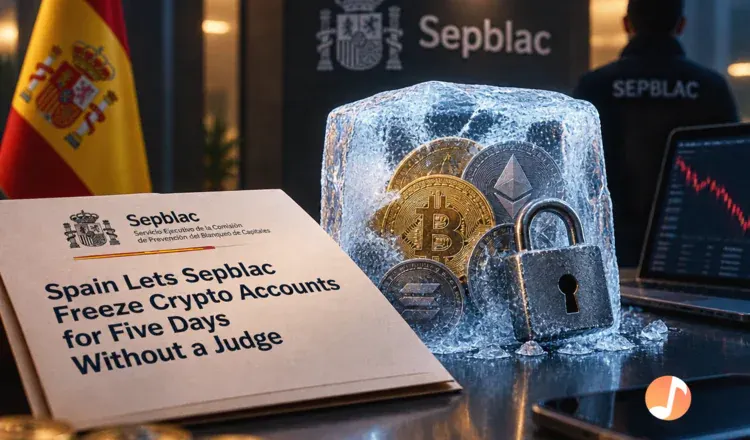
Spain's anti-money-laundering unit can now freeze a crypto account for up to five business days on its own authority. No judge has to sign off first. The power arrived as a new article 46 bis inside Ley 10/2010, the country's main anti-money-laundering law, added by Royal Decree-Law 44/2026, dated 24 November and published in the Official State Gazette on the 25th. Bank and payment accounts are covered on the same terms, and a transaction already in progress can be held for up to ten business days. The decree-law's own subject is consumer credit; the amendment is one item among many across 178 pages.
What article 46 bis allows
The measure reaches further than single accounts. Sepblac, Spain's financial intelligence unit, can suspend the use of a bank, payment or cryptoasset account and also the wider business relationship between a customer and a provider, where it finds indications of a link to money laundering or the financing of terrorism. Five business days is the ceiling for that. The ten-day limit applies separately, to one transfer caught in flight. Both end sooner if Sepblac decides they are no longer needed, and both lapse when the clock runs out unless a court ratifies or extends the order on a prosecutor's request filed before the deadline. Crypto Briefing and Finance Magnates, filing hours apart on Thursday, agree on those numbers.
Article 46 bis lets Sepblac "suspend or not authorise transactions and suspend the use of bank, payment or cryptoasset accounts and business relationships where there are suspicions of a link to money laundering or the financing of terrorism," the decree's preamble said, translated here from the Spanish.
Who has to carry out the order
Crypto firms were already inside the perimeter. Cryptoasset service providers fall under Spain's main anti-money-laundering law as it stands, so the change is less about who is covered than about how fast they have to move. Platforms have to put a Sepblac order into effect and then lift it inside the five- or ten-day window. Finance Magnates reported that a failure to comply is classed as a very serious infringement, and that the decree also shields firms from liability when they restrict an account on Sepblac's instructions. Neither point appears in the other accounts read here. Korea's regulator reached a similar end by another route when it let exchanges freeze withdrawals on suspected hacks themselves.
Two commencement dates, neither confirmed
The dates do not reconcile. Crypto Briefing reported that the provisions take effect on 25 January 2027, subject to parliamentary approval of the decree. Finance Magnates gave no commencement date and said instead that the decree-law stays provisional until Spain's Congress validates or rejects it within 30 days of adoption, a window that would close around 24 December. That is a month earlier than the other figure, and the two describe different things: validation of the instrument is not entry into force of one article inside it. The decree's own preamble says only that its fourteenth final provision governs entry into force and sets staggered deadlines for certain obligations, naming high-cost lending duties and credit-cost limits. Article 46 bis is not among those it names. We could not establish which deadline governs it.
Still unwritten
Both outlets tie the change to the Financial Action Task Force, the global standard-setter whose recommendations require financial intelligence units to hold effective powers to halt suspicious transactions. Crypto Briefing goes further, reporting that the government framed the amendment as closing gaps ahead of an FATF evaluation of Spain. That framing rests on one account. The same outlet said Sepblac could previously suspend an account only when a foreign counterpart asked it to, which would make acting on its own analysis the whole of the change. Nothing in the three sources describes how a customer learns an account has been suspended, or what they can do inside those five days. Switzerland cleared 57 jurisdictions for crypto tax data in 2028 on Thursday, so Spain is not alone in widening reach this month. The recourse question is one a frozen account holder asks first, and the decree as published does not answer it.
Read also: Dubai's VARA Signs an Intelligence-Sharing Deal With the UAE's FIU