
A $150 Miner Solves a Block Alone for 3.1382 BTC
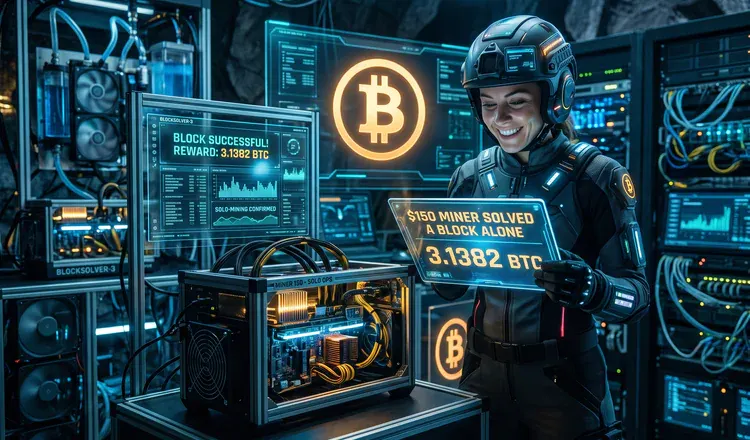
A hobbyist running a Bitaxe, a palm-sized bitcoin mining unit built on Bitmain's BM1370 chip and costing about $150, solved block 957382 alone at roughly 03:30 UTC on July 9 and took the entire reward of 3.1382 BTC, worth about $200,000. The device was hashing at 995.2 GH/s, near its rated one terahash per second, against a network running at about 900 EH/s. It had been switched on for roughly eight hours when it found the block. It was pointed at Public Pool in a solo configuration charging no fee, which pays the whole reward to whoever finds a block rather than dividing it among contributors. CoinDesk reported it as the second documented solo win on that pool attributed to a Bitaxe.
All of the reward or none of it
Mining is a repeated guessing game. Each machine assembles a candidate block and hashes it over and over with a changing input, and the first miner anywhere to produce a hash below the network's current target publishes that block and claims its reward. The search is random, so machines differ only in how many guesses per second they make, and hashrate is the measure of that. Pooled mining smooths the randomness out: many machines report partial results to a coordinator, which pays each participant in proportion to the work contributed, so income arrives in small, regular amounts.
Solo mining removes the sharing. The machine searches alone and earns nothing for as long as it fails. On the rare occasion it succeeds, it keeps the full reward. Public Pool in solo mode still supplies the block templates and the network connection a lone device would otherwise have to run itself, but it passes the reward through intact.
An expected wait of 16,000 to 18,300 years
At 995.2 GH/s against a network of roughly 900 EH/s, the device accounted for about one billionth of the search, and on that share the expected time to find a block was put at 16,000 to 18,300 years. That is an average over an enormous number of trials. It is not a countdown. Every hash is an independent attempt, so a machine that has run for eight hours is no closer to a block than one switched on a minute ago. The same statistics that make the expected wait so long also allow a win in the first eight hours, because there is no progress to work through.
The denominator moves. The target a miner has to beat is reset by the difficulty setting that adjusts as total hashrate joins or leaves the network, which keeps blocks arriving at a steady average rate however much hardware is running. When hashrate falls, difficulty follows, and every remaining machine's share of the search rises by a few percent, not into a range where a home unit can expect a block in a lifetime.
New coins plus the fees in the block
A block reward has two components. The first is the subsidy, a fixed quantity of new bitcoin the protocol creates for each block and pays to whoever produced it. The second is the fees on the transactions the miner chose to include, paid by users competing for limited space in the block. The 3.1382 BTC reported here is the sum of both. The coverage did not break out how much came from fees, the part that varies block to block. A single compilation of public ledger data, uncorroborated elsewhere, put the network as running at its highest daily transaction counts of 2026 through the first half of the year.
A win that leaves the odds untouched
One outcome does not alter the arithmetic behind it. The same device faced the same expectation the following morning, and a solo miner's income stays at zero in every interval that does not contain a block. What the win demonstrates is narrower than it appears: a consumer device on a solo pool competes on the same terms as an industrial fleet, and the protocol makes no distinction when a valid hash arrives. With two such wins now documented on Public Pool, the sample is small enough that the next one will be news as well.
Read also: Bitcoin's Difficulty Drops 5% in the Month's Second Big Cut