
The ECB Maps Three Routes to Putting Central Bank Money Onchain
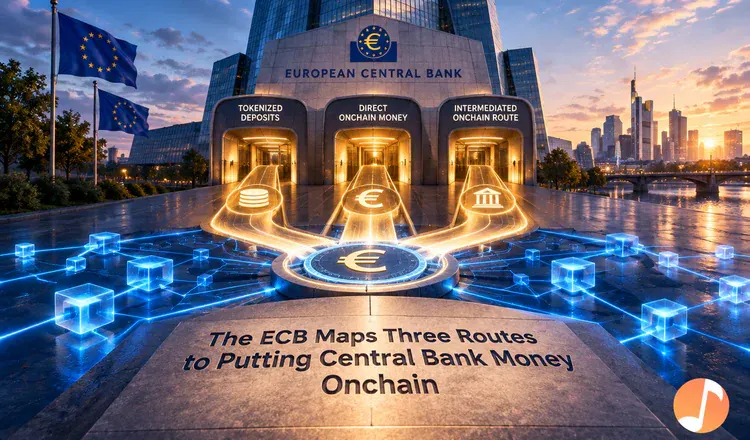
The European Central Bank has three designs for putting central bank money onto a blockchain and no decision between them. Isabel Schnabel, a member of the bank's Executive Board, set them out on Thursday at the Bank of England's Future of Money conference in London. The first would issue reserves directly onto a programmable platform. The second would leave the existing settlement system in place and connect it to distributed ledgers through a linking layer. The third would tokenize reserves and let a private intermediary issue settlement tokens backed by them.
Three designs, three sets of trade-offs
Take them in order. Direct issuance is the simplest technically, on The Cryptonomist's reading, and the furthest from the way reserves reach banks today. The second option keeps the ECB's real-time gross settlement system running and links it to distributed ledger platforms by hash, so no reserve is tokenized at all; Genfinity described the link as a trigger, with the reserves staying off-chain. The third puts distance between the central bank and the token itself. The Block reported the passage as the ECB issuing "settlement tokens fully backed by those reserves", which "would be private claims, rather than claims issued directly by the central bank". The Cryptonomist renders the same line with "itself" added at the end. Neither outlet reproduces the speech in full, so the exact wording stands unconfirmed.
What tokenization is supposed to buy
Tokenization can "make financial transactions more programmable and atomic, allowing the transfer of an asset and its payment to occur together," Schnabel said.
Both of those words carry weight. Programmability means settlement rules that execute on their own, without an instruction at each step. Atomicity means the legs of a transaction settle together or none of them settle at all; a payment that lands without its asset is the outcome the term exists to rule out. FinanceFeeds carried both definitions in the same form.
Pontes is already model two
One of the three is in production. The Eurosystem launched Pontes on 21 September, a platform supplying tokenized central bank money for wholesale settlement of tokenized securities, deposits and stablecoins on market distributed ledger networks. Three accounts give that date; The Block says only September 2026. Pontes settles through either TARGET Services or the ledger side, which is the interoperability design working in the open. The Crypto Times alone reports that full implementation is targeted for 2028 with round-the-clock availability, and no second account carries it.
Appia is the longer study. It examines a single unified ledger, interconnected networks, and multiple shared ledgers holding central bank money alongside other digital assets. The Crypto Times, again by itself, puts a blueprint at 2028.
Why the central bank wants the floor
Schnabel's reason for treating any of this as the ECB's business is the two-tier system: central bank money underneath, commercial bank deposits above. That structure survives tokenized markets, on her argument, as long as the bottom layer is reachable onchain, with stablecoins and tokenized deposits coexisting as complements. Canada's regulator reached the layer above from the other direction when it ruled that tokenized deposits are not legally distinct from ordinary ones. Genfinity's account has her reaching for history as well, citing the Panic of 1907 and the COVID-19 shock as episodes in which only a central bank could expand liquidity quickly. No other account read here carries that passage.
Nothing was decided on Thursday. No proposal opened, no consultation started, and no date exists for a Governing Council choice between the three. Nobody has costed one design against another in public. Pontes implements the second; whether that leaves the other two as live options or as quietly settled questions goes unaddressed in every account read here. The separate digital euro work keeps its own schedule, with the merchant call for the pilot closing on 27 October. Appia's blueprint is where a preference would first become visible.
Read also: Lloyds and Visa Settle $750,000 in USDC Over a Seven-Day Pilot