
ECB Asks EU Online Merchants to Join Its Digital Euro Pilot by 27 October
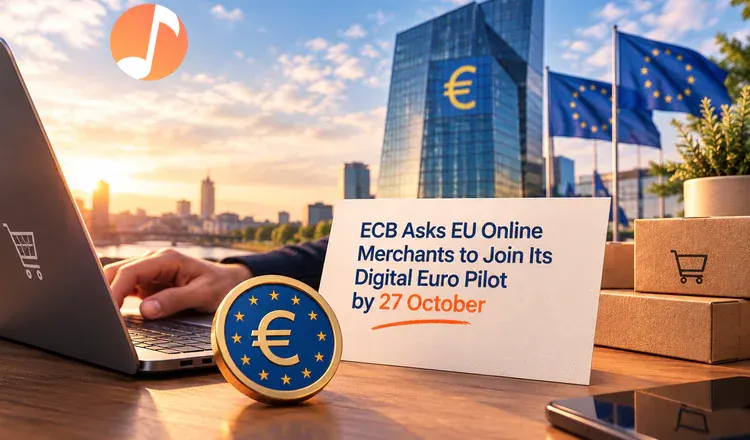
The European Central Bank is looking for shops. It published a call for expression of interest on Tuesday addressed to e-commerce and mobile-commerce merchants established in the EU, inviting them into the digital euro pilot whose technical phase starts this quarter. Applications close at 17:00 CET on 27 October. Merchants who are selected will accept payments in a test version of the currency, made by central bank staff, and will be neither paid for taking part nor charged for the service. None of it settles whether the digital euro is ever issued.
What an applicant needs
The conditions in the call are narrower than an open invitation. An applicant must:
- be legally established in the European Union;
- serve customers in at least two of the pilot's locations;
- run an active e-commerce site or mobile app suitable for the test;
- accept contracts with the ECB and with an acquiring pilot payment service provider;
- have a platform flexible enough to integrate the beta digital euro.
Submissions go to a named ECB mailbox with a completed questionnaire and a signed declaration attached. How many merchants get in is not stated anywhere in the document. The final number, the call says, "will depend on the number of eligible applications received and the need to ensure adequate coverage of the pilot objectives". That is a sentence about coverage, not a target.
Two years before anyone spends anything
The pilot runs in two phases on the ECB's own schedule. Development covers the third quarter of this year to the third quarter of 2027 and takes in onboarding, integration and technical setup. The operational phase follows with twelve months of live transactions, from the third quarter of 2027 to the third quarter of 2028. The ECB's pilot page describes the same exercise more loosely as a 12-month pilot starting in the second half of 2027, and its FAQ adds that the operational phase can run six months longer if needed. First issuance is pencilled in for 2029, conditional on the digital euro Regulation being adopted in EU law and on a Governing Council decision.
The money in the pilot is not the currency
What changes hands is a beta digital euro. The ECB's FAQ describes it as a liability issued by the central banks against funds they receive from payment service providers, distinct from the currency itself and working as scriptural money inside a closed environment. Book entries, in other words, not legal tender.
The general public is not in it. Only Eurosystem central bank staff act as individual end users, and the business side is limited to contracted merchants. Four use cases sit on the list: person-to-person transfers online using identifiers, offline person-to-person over NFC, in-store payments at the till over NFC, and e-commerce and mobile-commerce payments. Tuesday's call covers the last of those.
A decision the pilot does not make
"The pilot does not pre-empt any decision to issue the digital euro," the ECB's FAQ says.
That sentence is the boundary around everything else. The Eurosystem picked 36 payment service providers in July from more than 50 applicants, among them Deutsche Bank, UniCredit, Adyen, Revolut and Stripe, and the ECB plus 19 euro area national central banks are running the exercise between them. Piero Cipollone, who sits on the ECB's Executive Board, said at that July selection that "strong market interest shows the private sector's readiness to help advance the digital euro and strengthen European payments". The quote belongs to July. Nothing published on Tuesday carries a comment from an ECB official at all.
CoinDesk's account frames the bank's interest partly around the spread of dollar-backed stablecoins in Europe, a framing the call itself does not use. Private euro-denominated alternatives are being built in the meantime, and Revolut rolled EURR out to Denmark, Poland and Portugal while a group of 21 banks and asset managers aims at 2027 with a dollar token. An applicant has six weeks to decide. The call names neither the pilot locations nor the number of merchants the Eurosystem will take, so applying means committing before either is known.
Read also: Binance Stops Serving EU Users as MiCA's Transition Window Closes