
Bitcoin Suisse Cuts Up to Half Its Swiss Staff and Closes Copenhagen
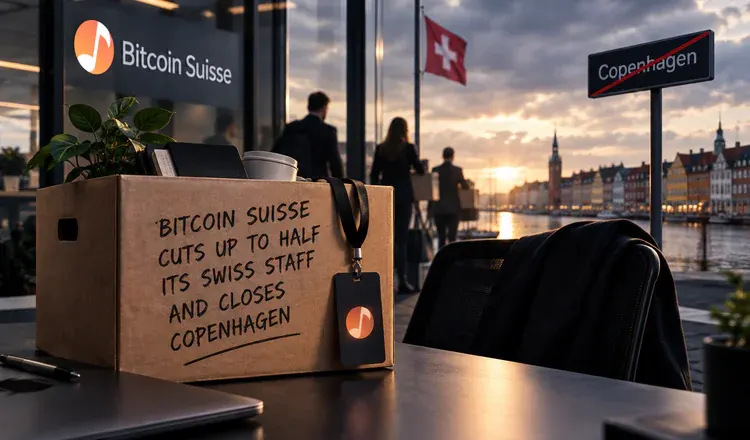
Bitcoin Suisse plans to cut up to 60 jobs in Switzerland, about half the staff it employs there, and to move software development and back-office work to cheaper locations abroad. The Zug company employs roughly 200 people in all, around 120 of them Swiss-based. Its Copenhagen IT site closes. The work goes to Bratislava, where it already has a hub, and to a new one in Vietnam whose location has not been disclosed. A staff consultation runs to 20 September, and the final count depends on what comes out of it.
What moves and what stays
The roles at risk are back-office, administrative and software engineering, in the accounts given by CoinCentral and Blockonomi. Client-facing wealth management stays in Switzerland and the Zug headquarters is not closing. Custody, trading, staking and lending products carry on unchanged. Chief executive Andrej Majcen gave CoinDesk the reason in a sentence.
"In Bratislava and Vietnam, we can provide these services at significantly lower cost," Majcen said.
He also said the restructuring follows an international growth plan and is not driven by weakness in the crypto market, a framing CoinDesk, CoinCentral and Blockonomi all report in near-identical terms. A company statement carried by The Crypto Times describes the same consolidation as supporting "scaling, access to broader talent pools, and investment in its future offering." How many of the 60 actually go is not settled. Nothing is decided before 20 September.
Two figures for the same pile of assets
The accounts of how much the firm holds do not line up. CoinDesk says Bitcoin Suisse has more than $3 billion in digital assets under custody. CoinCentral and Blockonomi both give it as 3 billion Swiss francs, which at current rates is nearer $3.7 billion. The difference is the currency, not the arithmetic, and none of the three points to a filing behind the number. The same two outlets put the firm's equity at 95 million Swiss francs as of January. CoinDesk carries no equity figure at all.
Licences collected in three jurisdictions
The offshoring lands on a company that has spent 2026 acquiring permissions outside Switzerland. CoinDesk reports that its Liechtenstein subsidiary was authorised in June under the EU's Markets in Crypto-Assets regime, the bloc's single rulebook for crypto firms, opening selected European Economic Area markets to it. Ripple travelled a similar route when it won a full MiCA licence in Luxembourg. CoinCentral and Blockonomi add a Bermuda licence this year and full authorisation in Abu Dhabi in July, covering trading, custody, staking and lending. The Gulf has been drawing licensed desks all year, Standard Chartered among them when it opened spot bitcoin and ether trading to UAE institutions. Blockonomi alone says the company walked away from a Swiss banking licence application in 2021, and that line stands unverified here.
Payrolls have been shrinking all year
Bitcoin Suisse is not the first crypto firm to cut this year, though the comparison is thinner than it looks. The Crypto Times lists Bitwise Asset Management cutting 14% of staff in August and the Ethereum Foundation losing 54 people in June, about a fifth of its workforce. Yield Guild Games shed 35 jobs in July. No other outlet in this sweep repeats that tally, and the three cases are different enough that reading them as one trend would be a stretch. Majcen's account puts his own company outside it: the cost of delivering a service, not a business in retreat. The test of that is what Bratislava and a hub nobody has located yet can absorb. Sixty is the ceiling, and the consultation closes on 20 September.
Read also: Consensys Splits MetaMask Off and Says Nothing About an IPO