
What Is Token Burning? Why Projects Destroy Their Own Coins
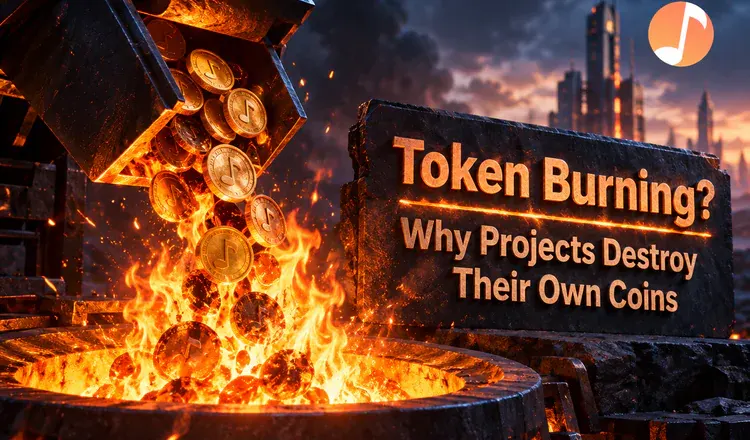
Token burning is a project permanently taking some of its own coins out of circulation. The coins are sent to an address that has no key — a wallet nobody can ever open — so they sit on the blockchain in plain view and can never be moved again. Everyone can check the balance; nobody can spend it. The practical effect is that the number of tokens left for people to buy, sell and hold gets smaller.
It works the way a central bank shredding worn banknotes does. The notes were real money, they are counted out of the total, and after that they are just paper in a bin.
Why would a project destroy its own money?
Usually to shrink supply. Ethereum does it automatically: since the 2021 fee change, part of the fee on every Ethereum transaction is burned rather than paid to anyone, so busy days on the network destroy more ETH than quiet ones. BNB runs a scheduled burn every quarter, aiming to cut its supply down to 100 million coins, plus a smaller ongoing burn of network fees. Tether burns USDT for a much duller reason: when someone cashes out dollars, the matching tokens are destroyed so the number in circulation still lines up with the money held.
Does a burn make a coin worth more?
Not on its own, and this is where beginners get caught. Supply is only half of the picture — demand is the other half, and burning tokens does nothing to create it. A burn of one percent of an enormous supply is mostly a press release. The questions worth asking are whether the burn is written into the code or merely promised in a blog post, how big it is next to the total supply, and whether the project can simply mint new tokens later and undo the whole thing.
How can you check a burn actually happened?
Look it up yourself. Burn addresses are public, often ending in a recognisable string of zeros or the word "dead", and every transfer into them shows up on a block explorer with a date and an amount. If a project announces a burn and you cannot find the transaction, that is your answer.
Treat any burn announcement as a claim to verify rather than news to act on, and never buy a token because a burn is scheduled. Our guides to burning crypto and block explorers show you how to check one in a couple of minutes.