
Solo Mining Odds by Hashrate: The Numbers for Every Size of Miner
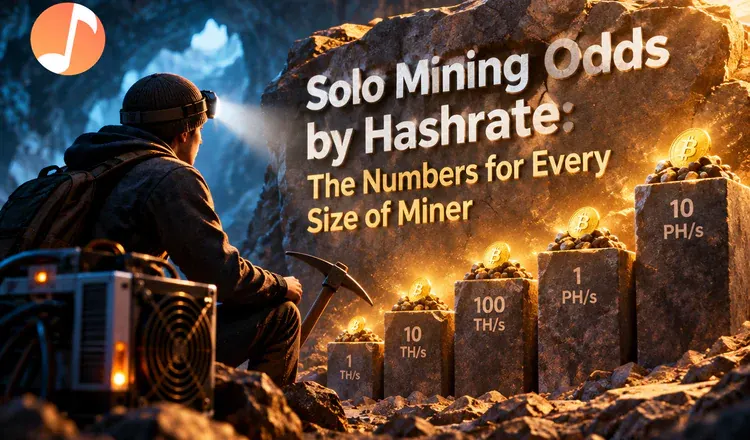
Solo mining odds by hashrate come down to one line of arithmetic: your share of the network's hashing power is your share of the blocks. Bitcoin produces a block about every ten minutes, 144 a day, and the winner is simply whoever stumbles on a valid answer first. Supply a millionth of the world's hashing and you should expect a millionth of the blocks. Nothing else about your setup changes that.
How the odds are worked out
Difficulty sits at roughly 148 trillion, which is a way of saying a block takes about 637 billion trillion guesses on average across the whole network - near enough 1,000 exahashes a second for ten minutes. Divide that figure by your machine's hashrate and you have your average wait. The sum is identical for everyone; only your own top line changes.
Machine by machine
- 1.2 TH/s, a Bitaxe Gamma: one block every 17,000 years on average, about 1 in 6.1 million on any given day.
- 10 TH/s, a few small boards together: roughly 2,000 years, about 1 in 740,000 a day.
- 70 TH/s, an older full-size ASIC: roughly 290 years, about 1 in 105,000 a day.
- 200 TH/s, a current Antminer S21: roughly 100 years, about 1 in 37,000 a day.
- 1 PH/s, five of those S21s in a shed: roughly 20 years, about 1 in 7,400 a day.
Why an average is not a schedule
Each guess is independent, like a coin flip that never remembers the last one. A seventeen-thousand-year average does not mean waiting until the year 19000 - it means the chance is the same tiny number today, tomorrow and after a decade of running, and a one-week-old Bitaxe can beat a warehouse. The averages also drift the wrong way over time: as more machines join, difficulty rises, and every existing miner's slice shrinks without anyone touching their hardware.
Before you buy anything, do the one calculation that applies to you: multiply the machine's wattage by your electricity price for a year, then set that against the per-year odds above and decide whether you would pay it for the ticket. The small end of the range is examined in the chances a Bitaxe finds a block, and how real winners have fared is in bitcoin lottery miner real odds.