
Aave V4 Takes Coinbase Stock Tokens as Collateral for USDC Loans
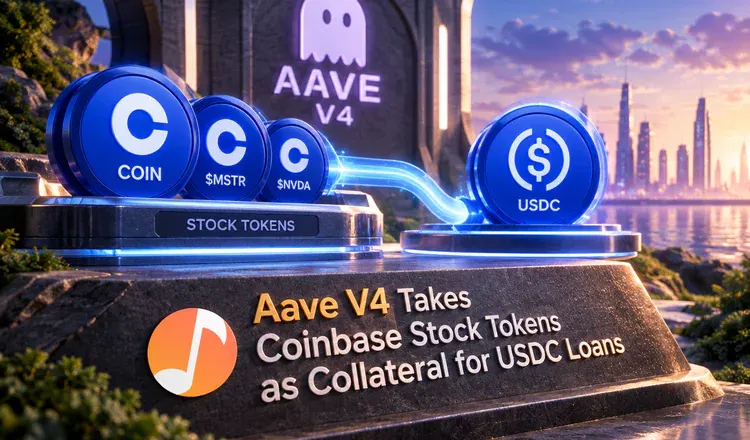
Aave opened a lending market on Base on Friday that takes tokenized US stocks as collateral. Seven Coinbase-issued equity tokens are accepted at the start: Apple, Amazon, Alphabet, Meta, Microsoft, Nvidia and Tesla. Borrowers post them and draw USDC, at collateral factors set between 65% and 79% depending on the share. The market opens small. Total collateral is capped near $29 million and USDC borrowing at $21 million, and only users outside the United States in permitted jurisdictions can reach it.
How the seven share one pool
The market runs on what Aave calls its Hub and Spoke design: the seven stock tokens feed a single USDC liquidity pool while each keeps its own risk parameters, so trouble in one share does not spread across the others. Supply into that pool is capped at $32 million. Chainlink provides the price feeds. GHO, Aave's own stablecoin, may be added as a second borrowable asset if governance approves, an item The Block, PANews and Phemex all carry and none dates.
Those three accounts print identical parameters, which is more agreement than this desk usually gets on a launch day. The Defiant carried the seven-token count and the $21 million borrowing cap in its headline; we could not load its body.
Kulechov's pitch and Chainlink's number
"Until now a tokenized stock was something you could hold or trade. Today it becomes something you can borrow against," Stani Kulechov, founder and chief executive of Aave Labs, said in remarks carried by The Block on Friday.
Kulechov said in August that Aave would be the first lending venue where Coinbase stock tokens could be supplied and stablecoins borrowed against them. Chainlink's chief business officer, Johann Eid, framed the opening as the "$150+ trillion global equities market" in a statement issued with the launch. That is a vendor's estimate of a market, not a measure of anything onchain. Aave's own scale is reported once and without a window: The Block credits the protocol with $3.6 trillion of cumulative deposits and more than $1 trillion in all-time loans. A dated figure sits closer to hand. Total assets supplied stood at $31 billion on 25 August, 23% above where they had been 30 days earlier.
The collateral is a month old
Coinbase's stock tokens began trading on 24 August with Nvidia, Apple, Meta and Alphabet, and six more followed on 4 September. Each is backed one-for-one by shares in regulated custody, by Crypto Briefing's account, with Alpaca holding them under Abu Dhabi Global Market supervision and dividends passed through to token holders. The structure is Regulation S, and US persons are excluded from it, the same boundary Aave's new market draws.
How much has traded depends on who counted what. Crypto Briefing put cumulative decentralized-exchange volume at $228 million over the first month. Cryptonomist, writing on 24 September, put the first month at $1 billion and described it as exchange volume on Coinbase's own platform. Those count different venues, and neither account reconciles with the other. By 17 September the tokens made up about 7% of all DEX activity on Base, on a figure Crypto Briefing published without naming its source. Across all issuers the numbers run larger: RWA.xyz counted $29.5 billion in tokenized-stock transfers over 30 days, a measure of movement and not of trading on any one venue.
What the caps leave open
Twenty-nine million dollars of collateral is a test, not a business. Governance can lift the caps, and the same route would admit GHO or further Coinbase tokens. Two things Friday's launch does not settle. The shares behind these tokens trade on exchanges that close, while the market lending against them runs every hour of the week, and none of Friday's accounts addresses that gap. The risk design underneath is also new: the DAO voted to put its own money in front of stakers in three V4 markets earlier this year. No account in this sweep describes an equity-collateralized liquidation running through any of it.
Read also: NYSE and Blockchain.com Sign an MOU on Tokenized US Stocks