
Aave Plan Would Put DAO Money Before Stakers in Three V4 Markets
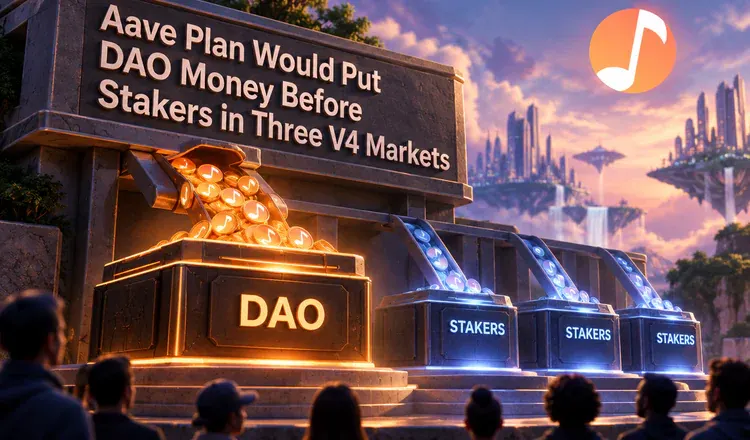
A proposal on Aave's governance forum would make the protocol's own treasury the first money lost when a lending market goes bad. TokenLogic posted the framework on 11 September, covering three markets on Aave V4's Ethereum deployment: Core WETH, Core USDC and Core USDT. Under it a shortfall eats a DAO-funded buffer before reaching the capital stakers have put up. The buffers are small next to the markets they sit in front of. Nothing has been voted on and nothing is live.
The order the money burns in
Umbrella is Aave's staking-based safety net, the replacement for a Safety Module that needed a governance vote to fire. Suppliers stake aTokens, the interest-bearing receipts a lender holds, and earn emissions for accepting the risk those tokens get burned. When a market ends up with a deficit, meaning debt the collateral no longer covers, Umbrella burns staked tokens automatically. The deficit offset is the layer this proposal puts in front of that. Aave's documentation gives the shape of it: a 100,000 USDT offset means the DAO absorbs the first 100,000 USDT of a deficit before any staker loses anything.
Coverage does not travel between markets. The post is explicit.
"Coverage and Deficit Offsets are defined per (Hub, asset), meaning capital committed to one Hub asset cannot clear a deficit in another," the proposal said.
Eight hundred ETH and two stablecoin pools
The numbers are modest. WETH gets a target of 800 ETH of staked coverage behind a DAO offset of 33 ETH, paying 20.8 ETH a year in emissions, an APY of 2.6%. USDC and USDT each get 400,000 of coverage behind an offset of 15,000, paying 12,800 a year at 3.2%. Every parameter there was read off the forum post. CryptoSlate, the only outlet in this sweep carrying the proposal, adds that TokenLogic sized the targets to cover six to eight weeks of expected loan growth. That line is not in the post as we fetched it.
Exiting is slow by design. A staker who wants out waits 20 days, then has a two-day window to withdraw. The assets stay slashable throughout the cooldown, and keep earning through it.
Four markets left outside, and the reasons given
The proposal names what it will not cover, and why. Prime USDC and Prime USDT are out for "strong collateral coverage, limiting the incremental protection that Umbrella would provide". Global Dollar USDC and the Plus markets are out on scale and concentration. Core USDG is out because its five largest borrowers hold 49% of total debt. Core frxUSD has the "most concentrated supplier base among the Core stablecoin markets", with issuer-affiliated suppliers at roughly 47%.
Concentration is the objection against the covered markets too, from one commenter and not a second outlet. A reply dated 12 September says the 826 suppliers behind Core WETH include dust accounts and several wallets held by the same parties, and that 96% of the credit risk traces to one EtherFi leveraged strategy. Aave has not answered it on the thread. The same commenter asked for a notice period before new markets become Umbrella-eligible, so governance cannot reprice a staker's risk afterwards.
How little has ever had to be absorbed
Aave publishes a figure for how often any of this matters. Deficits run at about 0.000004% of outstanding borrows monthly across its deployments, on the protocol's own documentation, and nothing independent checks it. That explains the size of the offsets. It also means the framework goes into service untested at scale. V4 went live on Ethereum in April, and the protocol spent July moving to retire 50 reserves and six deployments on much the same logic. The losses that actually hurt DeFi this year came from elsewhere, with stolen keys costing more than code bugs.
What happens next is procedural and unscheduled. An ARFC is the discussion stage; a Snapshot poll and a binding on-chain vote both sit after it, with no date published for either. TokenLogic has asked for the framework to be re-run after three months, which reads as an admission that the first numbers are a guess at the right size.
Read also: Moonwell Loses About $8.7M to a Manipulated MAMO Collateral Price