
Fed Proposes Tiered Capital and Two-Day Redemptions for Stablecoins
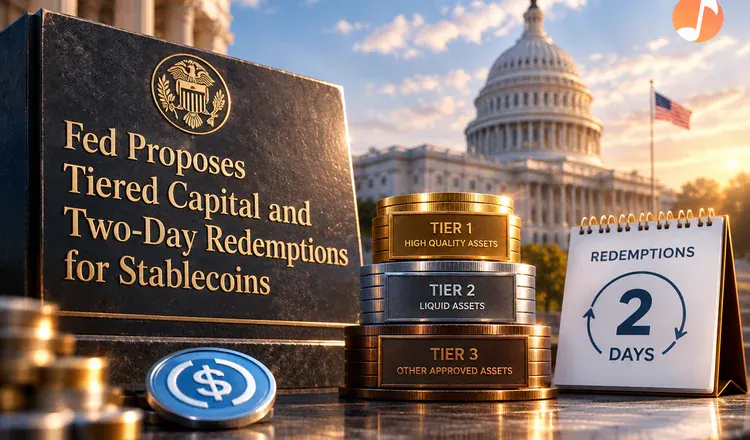
The Federal Reserve Board put two proposals out for comment on Thursday that would set the terms for the payment stablecoin issuers it supervises. The first covers reserves, capital, risk management and the custody of reserve assets. The second builds an application route for Board-supervised banks that want to issue a stablecoin through a subsidiary, with procedures for appeals and hearings attached. Comments run for 60 days from publication in the Federal Register. The GENIUS Act, the stablecoin statute enacted in 2025, bites on 18 January 2027, or 120 days after final rules are issued, whichever comes first.
A capital charge that thins as the book grows
The operational-risk charge is tiered. Issuers would hold 2% against the first $20 billion of coins outstanding, 1.5% against the next $30 billion, and 1% on anything above $50 billion. Cointelegraph and KuCoin's flash both carry all three bands. A comparison of 17 write-ups published by NewsCord found 16 of them aligned on the 2% and the 1% figures, without saying how many picked up the middle tier, and both Crypto Briefing and PYMNTS ran the story with no figures in it at all.
Reserves stay one-for-one. The permitted assets are cash, bank deposits and short-term US Treasuries, which the Board's release describes as "short-term Treasury bills and certain other high-quality, liquid assets." An issuer whose backing slips below the required level would have to tell the Fed and then either repair the shortfall or wind the coins down. Treasury set the first piece of this frame in place when it defined who may issue a payment stablecoin in August.
Two business days, and it has to be at par
Holders would get their money back inside two business days in normal conditions. The word doing the work is par, meaning a dollar of coin returns a dollar, with no haircut for the queue.
"Stablecoins will only be stable if they can be reliably and promptly redeemed at par in a range of conditions," Governor Michael Barr said in a statement issued alongside the proposals.
Barr backed the package and asked for one thing to be tightened: that universal redemption rights be made explicit in the final rule. His test is stress, not calm.
The requirement most of the coverage left out
Issuers would publish a monthly account of coins outstanding and the composition of the reserves behind them, examined by a registered public accounting firm and certified by the chief executive and the chief financial officer. The certification moves a reserve misstatement from a disclosure problem to a signed one. It went almost unreported. Of the twelve write-ups NewsCord compared on this point, ten omitted it, and only BigGo Finance and TradingView carried it. This desk read four accounts before finding the requirement in the Board's own release.
Last agency in, with the clock running
Forkast's sequence puts the OCC first in February, the FDIC in April, the NCUA in May, Treasury in August and the Fed on Thursday. Every one of them missed the statute's own 18 July rulemaking deadline. With Federal Register publication expected in the closing days of September, comments would shut in late November, leaving about seven weeks to the January date by Forkast's arithmetic. The OCC is separately said to be aiming at a final rule in November, which rests on PYMNTS alone.
The market these rules would land on is large and not precisely known. StablecoinBeat's tracker read $304.3 billion on Thursday afternoon, with Tether's USDT at $183.5 billion and Circle's USDC at $75.2 billion. Forkast, publishing at 19:34 UTC the same day, put the total at $307 billion. The two shares agree at roughly 60% and 24%. The totals are $2.7 billion apart and do not reconcile.
Barr's own unresolved objection sits elsewhere. He is concerned that a "significant or systemic" standard would keep the Board from acting on anti-money-laundering deficiencies that fall below that bar, an argument running back to the questions raised in comment letters on the customer identification rule. He asked for the final rule to address it. Nothing in the proposal does yet.
Read also: OCC Grants Agora, Catena and Bastion Conditional Trust Bank Approvals