
Bitcoin Reserve Bill Clears Committee 28-21 to Lock 324,527 BTC
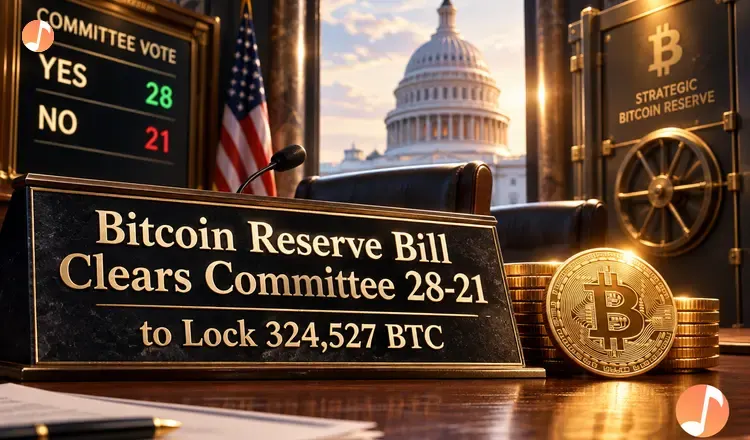
A bill that would hold the federal government's bitcoin for at least 20 years cleared the House Financial Services Committee on Wednesday, 16 September, by 28 votes to 21. The American Reserve Modernization Act of 2026, filed as H.R. 8957, would sweep roughly 324,527 BTC already in federal hands into a single reserve and bar any sale of it for two decades. Cointelegraph put that stack at $24.7 billion. BeInCrypto put it at $24.8 billion. The vote sends the measure to the full House, the first of several steps it still has to clear.
What the bill would lock away
The act buys nothing. It would fill the reserve only with coins the government already holds after criminal and civil forfeiture, according to Crypto Briefing's reading of the text, and move those coins out of scattered agency wallets into one centralized Treasury account. For two decades the Treasury could not sell, trade or otherwise liquidate them. Custody is the argument its sponsors have made since the bill was introduced on 21 May with more than 20 co-sponsors.
"We cannot allow Bitcoin to be held by the federal government to languish in fragmented and inconsistent custody," the bill's lead sponsor said.
The text adds a reporting duty on top of the custody consolidation: quarterly public proof-of-reserve audits, with cryptographic attestations checked by an outside auditor. Proof of reserve is a published cryptographic check that the coins exist and sit where the holder says they do. Exchanges took the practice up after 2022. Applying it to a federal balance sheet is new.
Two totals that do not reconcile
The $24.7 billion valuation comes from Cointelegraph's report on Wednesday and matches the figure circulating with the story. BeInCrypto, writing about the same markup, priced the same 324,527 coins at $24.8 billion. The gap is about $100 million, or close to $300 a coin, which is the spread that opens when two desks value one stack at different minutes of a moving market. They do not reconcile. We could not establish which price each outlet used.
The 20-year floor and the 28-21 tally hold up across both accounts, and Crypto Briefing carried the same 20-year restriction from the bill text. One framing circulating with the story does not survive a check. It said the government had voted never to sell its bitcoin. A committee is not the government, and the bill sets a 20-year minimum instead of a permanent ban. The same post called this the first bitcoin reserve bill to clear a full House committee; no outlet carried that claim by publication time, and it stands unverified.
The road past the committee room
A committee vote moves a bill and nothing more. The act has to pass the full House and then the Senate before it can be signed into law, and the Senate is where this year's crypto legislation has stalled. Two days before the markup, the Clarity Act missed the 60 votes it needed and bitcoin slid with it. Supply for the reserve carries its own open question, because forfeited coins can be clawed back in court. The largest contested case, an $11 billion forfeiture now before the Supreme Court, is still live.
What changes on Wednesday's vote is narrow and real. A reserve that has until now existed as executive policy would become statute, with an audit schedule attached and a two-decade lock on sales. Whether the House floor agrees is the next test, and no date for it had been set at the time of writing.
Read also: U.S. Establishes BTC Reserve