
Eight eMudhra Signing Keys Were Small Enough to Guess in a Second
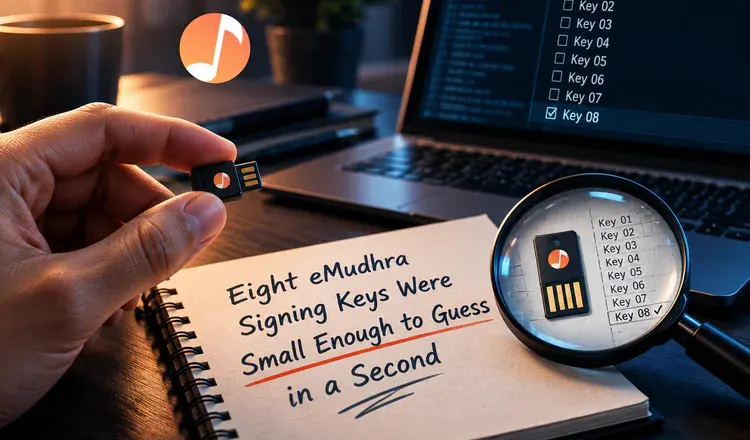
A company whose job is vouching for websites signed eight certificates with private keys small enough to write down. One of them was the number 4. Mozilla disclosed the compromise on Tuesday 20 October and shipped an update removing eMudhra's root, three days after a report reached browser makers. What reaches crypto is everything that is not a browser. Command-line tools and language runtimes that trading bots and wallet backends are built on took a forged chain with default settings, on the account of the researcher who recovered the keys.
Keys you can count to
eMudhra is an Indian certificate authority that says it has issued more than 60 million certificates, a figure The Register carried. Its eight affected intermediates sit on the P-384 curve, where a private key is meant to be a random 384-bit number. Scott Helme, the security researcher who published the values, found each one was a single byte padded out with 47 bytes of zeros. His table lists 4, 56, 66, 115, 155, 156, 230 and 237. Recovering them meant adding the curve's base point to itself until it matched the public key: 255 steps at most. He did all eight on a laptop in under a second.
"The key was effectively public from the day the certificate existed," Helme wrote.
Credit for the values splits. The Register gives 4, 56 and 115 to Helme and the other five to unnamed researchers; Helme's own post carries all eight. Ars Technica described the key sizes as 3 to 8 bits, the same measurement in different units. The intermediates were created in April 2025 and cross-signed a month later by Sectigo's AAA Certificate Services root, so each key sits in two certificates. Sixteen in all.
Revocation reaches only the software that looks
Mozilla received the report at 20:06 UTC on Saturday 17 October, by The Register's timing, and had a block in Firefox hours later. CoinDesk dates Chrome's block to the same day, Apple's to 19 October and Microsoft's to 20 October. Dennis Jackson of Mozilla's cryptography engineering team set out the exposure: the keys "could allow attackers to issue fraudulent HTTPS certificates for websites they do not control". Both eMudhra and Sectigo have revoked the certificates. Helme's objection is that much software never checks revocation at all, so revoking does nothing for those clients. CoinDesk names the researcher who filed the report as Wayne, and says he proved the flaw by signing a message with all eight keys. No other account read here names him.
Where a trading desk would feel it
Helme tested a forged chain against clients outside the browser. curl reported the certificate verified and Python completed the handshake. Node called the connection authorized. CoinDesk, carrying the same tests, adds Go and Java, and says the forged certificate was for Stripe's API. Exchange bots and wallet backends are commonly built on those runtimes. An attacker on the same network could in principle read or alter an API session. No crypto-related attack has been reported. Mudit Gupta, chief technology officer at Polygon Labs, told CoinDesk this "is not a crypto-specific issue" and called it a generic route to man-in-the-middle attacks, where someone sits between two parties and rewrites what passes. This desk has covered a backdoored package in Injective's npm SDK before, and separately a Lightning implementation that closed a browser route into a node's API.
The 17 months nobody can account for
Updated browsers are the manageable part. eMudhra's explanation, which Helme read off Mozilla's bug ticket, is that a bug in the key ceremony script created a second, weak key pair, and similar naming then put the wrong pair into the signing request. eMudhra has not responded to either The Register or CoinDesk. The affected intermediates run until July 2039, and devices that will not take an update keep trusting them: routers, printers, appliances with firmware nobody will touch again. The keys were created in April 2025 and reported in October 2026, leaving about 17 months in which anyone who looked at one of these certificates could have recovered it. Nothing in the public record says whether anyone did.
Read also: Polymarket Users Lose $3.1M in a Frontend Supply-Chain Attack