
ASIC Proposes A$14M Capital Floor for Self-Custodying Platforms
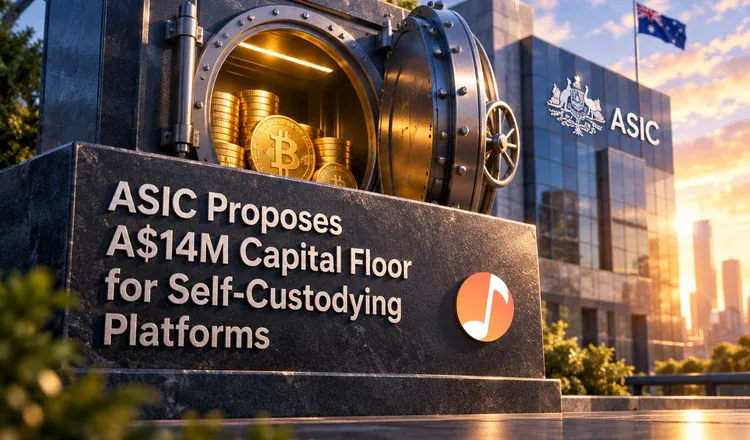
Australia's corporate regulator put its licensing standards for crypto platforms out for comment on Thursday, and the figure that leads the paper is a capital floor. Operators that keep customer assets in-house, instead of using a qualifying third-party custodian, would have to hold at least A$14 million in net tangible assets or 10% of average revenue, whichever is greater. The same document sets out quarterly wallet reporting, seven-year record keeping and limits on a platform trading against its own customers. Submissions close on 27 November. ASIC wants final guidance out in March.
Three capital models, one hard floor
Consultation Paper 392 was published on 15 October and covers two newly defined categories: digital asset platforms, which take in exchanges and custodians, and tokenised custody platforms, which handle tokenised versions of real-world assets. The A$14 million tier appears in the same terms in The Crypto Times, FinanceFeeds and TechTimes, two of which convert it to about US$9.7 million. Platforms that meet the third-party custody conditions would start from a A$200,000 base, with further amounts calculated against assets or revenue. The Crypto Times is alone in describing the other two models ASIC is weighing: a A$7 million threshold for operators holding nothing classified as a financial product, and a third model built from activity add-ons of A$500,000, A$750,000 and A$1 million. No other outlet checked reproduces those tiers.
"Same activity, same risk, same regulatory outcome," ASIC Commissioner Alan Kirkland said.
CoinDesk and TechTimes carry that wording identically. The Crypto Times renders the same principle as "same activity, same risk, same regulation" and attributes it to ASIC rather than to Kirkland.
What the custody rules would require
The custody section is largely a record-keeping regime. Platforms would separate customer assets from their own, keep verifiable records of every wallet address and account configuration, report those wallet structures to ASIC each quarter and retain the records for seven years. Private keys and seed phrases themselves stay outside the reporting, by The Crypto Times' reading. Assets would not have to sit in Australia; an overseas custodian is allowed if the platform discloses where the assets are held and explains the cross-border risk. Payment stablecoins sit on a separate government track, which three of the outlets note, so this paper is not the whole framework.
The keys that sit overseas
One question in the paper has no answer yet. ASIC is seeking feedback on whether an Australian operator should have emergency access to private keys held by an overseas parent or affiliate if that entity fails, which FinanceFeeds reports as an open consultation item. TechTimes goes further, writing that no Australian court could compel a foreign insolvency administrator to hand keys over, and that lost keys cannot be reissued the way legal title can. That stronger reading is TechTimes' own analysis and not language ASIC has used. The two accounts describe one gap at different volumes.
Two commencement dates on the record
The timetable is where the sources part. CoinDesk, The Crypto Times and FinanceFeeds all put commencement of the Corporations Amendment (Digital Assets Framework) Act 2026 at 8 April 2027, a year after Royal Assent. TechTimes says the date appears as either 8 or 9 April depending on the source, and tells operators to confirm it. The two accounts do not reconcile, and we could not establish which reading supersedes the other. Existing operators then have until 7 October 2027 to apply for a licence or vary one they already hold, and may keep operating while ASIC works through the queue. CoinDesk alone reports that more than 140 businesses have applied for authorisation to provide digital asset financial services.
What the industry does with the six weeks is the next thing to watch. Elsewhere in the region the response to unlicensed venues has been blunter: South Korea blocked 27 unregistered exchange sites this month. Europe took the licensing route earlier, and the EBA last week named USDC the first significant e-money token under MiCA. Whether ASIC's capital tiers survive the consultation intact is open; The Crypto Times says a second round is possible before March.
Read also: Kraken Clears Dubai's Final Licensing Stage and Plans Dirham Pairs