
ESMA Asks Whether Tokenized Collateral Survives a Default
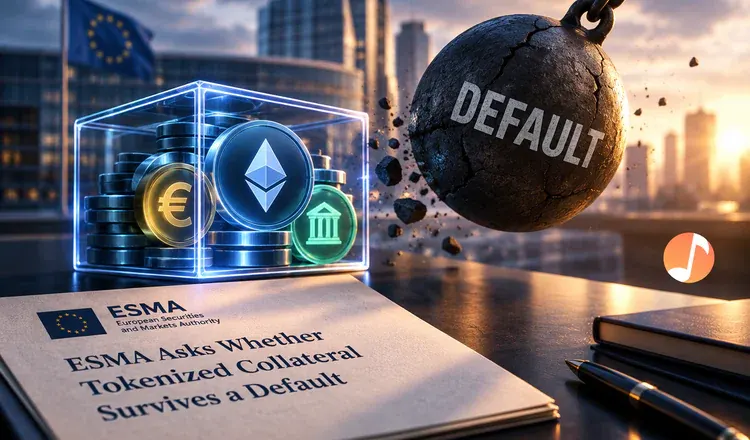
A clearinghouse that holds collateral has to be able to take it, move it and turn it into cash on the day a member fails. Whether a tokenised asset can be handled that way is the question the European Securities and Markets Authority put to the market on Friday. Its call for evidence, published on 9 October under the file reference ESMA91-1505572268-4934, asks how tokenisation would change the transfer, protection and use of collateral at EU central counterparties across the whole life of that collateral. Submissions close on 15 January 2027. ESMA says it will assess them in the first quarter of 2027 and then decide whether anything within its remit should change.
Digital twins, native issues and the hybrids
A central counterparty, or CCP, stands between the two sides of a trade and holds margin from each so that one side's collapse does not land on the other. ESMA's document names three arrangements it wants evidence on. The first is a tokenised version of an asset that still sits in traditional infrastructure, a digital twin. The second is an asset issued directly on a distributed ledger. The third is the hybrids, including how either of those interacts with tokenised cash and other settlement assets.
Verena Ross, who chairs ESMA, framed the exercise as opportunity rather than suspicion, saying tokenisation "has the potential to make Europe's financial markets more efficient, integrated and innovative." The questions underneath are mechanical.
The default is the test
What ESMA wants to know is whether a CCP could access tokenised collateral, transfer it and convert it into liquidity when it needs to, particularly after a clearing member defaults. It also asks how client protection, asset segregation and settlement finality would hold where a distributed ledger meets the market plumbing that already exists. Settlement finality is the point past which a transfer cannot be reversed, and it is a legal property in the EU, not a technical one. The last question is the sharpest: whether tokenising collateral that is already eligible changes its risk profile at all.
"Collateral must be of high quality, legally enforceable, highly liquid, and easily operationally available," said Klaus Löber, who chairs ESMA's CCP Supervisory Committee.
Nothing in it is numbered
The release carries no figures. There is no estimate of how much collateral EU clearinghouses hold, no count of the CCPs in scope, and no statement that any of them accepts tokenised collateral today. Neither of the two trade outlets that carried the story on Friday supplies one either, and the two quoted different fragments of the same statements: Securities Finance Times has Ross on ensuring tokenisation develops "safely and at scale across the Single Market" and Löber on tokenisation supporting "more efficient collateral mobilisation", lines that do not appear on ESMA's own page. Nothing in the accounts conflicts. They simply quote different parts.
A second January date for the same regulator
ESMA already has a January deadline running. It gave firms until 8 January to drop stablecoins that fall outside MiCA, a date that falls a week before this consultation closes. The collateral question is the slower one, and it is not only European: US rules are pushing the assets stablecoin issuers hold toward central clearing, with a 31 December date for eligible cash Treasury trades. Both sides of the Atlantic are asking what happens to a claim when the infrastructure underneath it changes.
Responses are published after the consultation closes unless a respondent asks otherwise, so the first public read on what banks and clearinghouses actually think arrives early in 2027. ESMA has committed to assessing the answers, not to acting on them; convergence action is listed as possible. Until then no EU rule has changed, and the regulator has not said that tokenised collateral is eligible or that it is not.
Read also: Solana Opens an MIT-Licensed Settlement Program for Institutions