
Bank of Korea Links Dollar Stablecoin Demand to Weaker Currencies
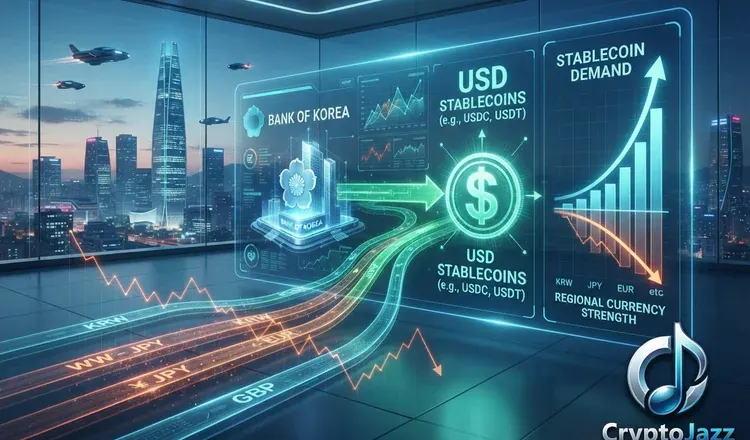
The Bank of Korea has put a measurement on something central bankers have argued about for two years. Researchers in its International Department found that where a large offshore exchange lists a direct local-currency pair against a dollar stablecoin, heavier stablecoin buying goes with a weaker local currency against the dollar. The note covers 2019 to 2025 and 12 currencies with enough cross-exchange data to measure, using tether's USDT and Circle's USDC. Korea itself is not one of the cases. Binance carries no won-stablecoin pair, and the won-dollar rate showed no statistically meaningful response.
What a direct pair does to the price
The premium is the tell. Local stablecoin premiums fell by 0.33 to 0.38 percentage points after Binance introduced direct fiat-stablecoin pairs, and all four accounts read for this piece carry that range identically. A premium here is the gap between what a dollar stablecoin costs in local currency at home and what it costs abroad. The mechanism the researchers describe runs through market makers. They supply stablecoins against local currency, then sell that currency and buy dollars in the foreign exchange market to square the position. Demand that used to stay inside a crypto exchange reaches an FX desk instead. Before the listings existed, the same relationship was statistically insignificant.
The paperwork around the note is less settled than its findings. Stablecoin Insider and Seoul Economic Daily date it 3 September and give it as Issue Note No. 2026-22; CoinDesk and Coin Edition carried it on 5 September without dating the document. The two authors are romanized two ways, as Jihyun Kim and Sangheum Cho at CoinDesk and as Kim Ji-hyun and Cho Sang-heum elsewhere.
Brazil carries most of the evidence
One currency does nearly all the work. A one-standard-deviation rise in Google searches for bitcoin, the study's proxy for retail investment appetite, is associated with a 0.118% depreciation of the Brazilian real on CoinDesk's reading. Seoul Economic Daily gives the same result as 0.12%, in two reports on consecutive days. Neither outlet refers to the other, and we could not establish which figure is the paper's own rounding. CoinDesk alone adds that the same shock lifted Brazil's stablecoin premium by 0.109 percentage points. Only Stablecoin Insider names other currencies in the sample, giving the euro, the Turkish lira and the South African rand. Both details rest on one account each.
Why the won sits outside the finding
Korea's market is not small. CoinDesk puts won purchases of stablecoins at $64 billion in the 12 months to June 2025 and calls Korea the largest local-currency stablecoin market in Asia-Pacific, a figure that appears in no other account reviewed here. What Korea lacks is the pipe. Without a direct won pair on the offshore venue, domestic activity is mostly retail traders moving existing holdings among themselves, and that demand never reaches the currency market. Stablecoin Insider reports a median won USDT premium of 1.67% since 2022 against a 30-currency median near 0.8%. It stands unverified.
Kim Ji-hyun, a manager in the Bank of Korea's International Department, said the link could strengthen "if the market structure changes, with wider participation by corporations and foreigners in domestic virtual asset exchanges," in comments carried by Seoul Economic Daily on 3 September.
The advice is a package, not a rule
The researchers do not ask for a prohibition. They argue that digital-asset rulemaking should move in step with internationalizing the won, and Stablecoin Insider adds deepening the domestic FX market as a third leg of the same programme. Seoul is already moving on the securities side, where the Financial Services Commission has set out tokenization starting in February 2027. The private build-out runs alongside it, and Coin Edition notes that 21 banks and asset managers plan a dollar stablecoin for 2027, with euro-linked tokens to follow.
The note sets its own test. Should a direct won pair list offshore, or corporations and foreign investors gain wider access at home, Korea stops being the control case in this dataset. No date has been published for either. What the Bank of Korea would do then, the note does not say.
Read also: Thai SEC Proposes Retail Access to Overseas Crypto Derivatives