
Coinbase Goes Down for 50 Minutes Over a Name Collision
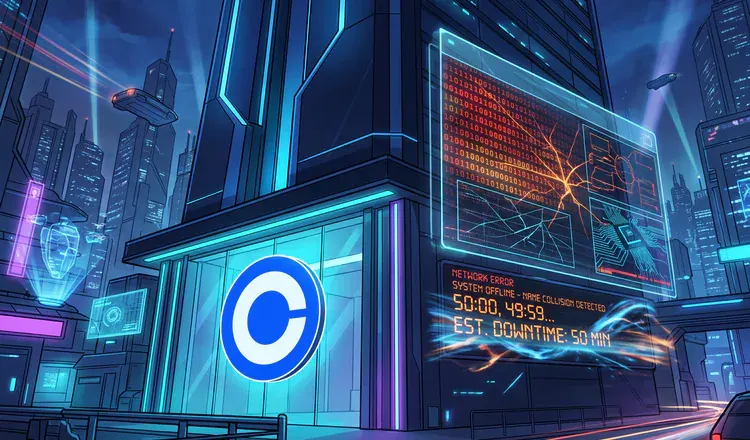
Coinbase's trading and transfer services were degraded for roughly 50 minutes on Tuesday afternoon after a routine configuration update disabled the gateway that routes inbound traffic into the exchange's production systems. The company's own timeline puts the update at 12:34 p.m. ET, with inbound cluster traffic stopping three minutes later, at 12:37 p.m. ET. The gateway came back at 1:20 p.m. ET. Coinbase marked the incident mitigated at 1:23 p.m. ET, put the end of degraded service at about 1:25 p.m. ET, and noted residual processing delays after that. Withdrawals, card payments and on-chain swaps were among the functions affected. No customer funds were at risk, the company said in its postmortem.
One name, two objects
That postmortem traced the outage to the update inadvertently modifying Kubernetes resources tied to the Istio ingress gateway. Kubernetes is the open-source system that schedules and runs the many small containers a service of Coinbase's size is assembled from, and an ingress gateway is the component that accepts connections from outside and hands them to the services behind it. Names are how Kubernetes identifies the objects inside a cluster. When a new definition claims a name an existing object already holds, the cluster can apply one configuration where the other was expected. That is what happened here. The gateway's own resources were altered, it became unavailable, and requests arriving from the public internet had nothing to route them onward. The exchange was running; nothing could reach it. Coinbase described the trigger as "a collision in resource names that was not detected by our pre-production checks."
What stopped working
Because the failure sat at the entry point rather than inside any one product, it cut across almost every surface Coinbase operates at once. The company listed the affected functions as:
- Transfers and withdrawals across the retail, institutional and developer platforms
- Coinbase Card debit transactions
- On-chain swaps on Base and Solana
- Settlement on Exchange and on Prime, the institutional venue
- Onboarding on the Developer Platform
The pattern is familiar from other shared-infrastructure failures: one component that everything depends on fails, and products with no functional relationship to each other stop working in the same minute. Coinbase said the disruption was to availability, not to balances or custody. Processing delays persisted after the gateway came back, as queued work cleared.
The second interruption in three weeks
It was the second outage in three weeks to land on infrastructure Coinbase runs. In late June, Base, the Ethereum layer-2 network the company operates, halted block production twice in two days, first for close to two hours and then for about 20 minutes during the restart, after a bug in its sequencer's block-building logic produced an invalid state transition. That episode delayed Base's Beryl hardfork and revived criticism of the network's reliance on a single centralized sequencer with no automatic failover. Tuesday's outage had an unrelated cause. It landed on the same operator, and in the same public ledger of downtime.
The timing was awkward in another respect. Inbound traffic stopped at 12:37 p.m. ET, the same minute the June consumer price index was released, and bitcoin ran roughly 4% higher over the afternoon to above $64,500 while parts of the exchange were unreachable. Market data cited that day put June spot bitcoin ETF outflows at $4.5 billion, with daily trading volume down 78% to $1.25 billion from a $5.8 billion peak — a thin tape, but an actively moving one.
The checks that let it through
Restoring the gateway took under an hour. The harder question the postmortem raises is why a name collision reached production at all. By Coinbase's own account, its pre-production checks did not detect the conflict, which places the gap in validation, not in the update itself. As of the postmortem's publication, the company had not detailed what changes to those checks will follow, and it gave no timeline for them. For institutional customers whose settlement paused for the better part of an hour, that is the piece worth watching.
Read also: Solana Raises Its Block Compute Limit 66% to 100M Units