
Binance Closes Its Mining Pool on November 10 After Six Years
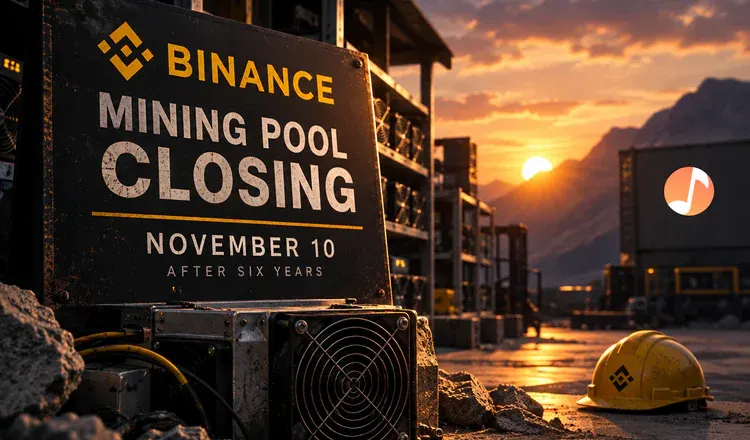
Binance will switch off its mining pool at 07:00 UTC on 10 November, closing a business it opened in April 2020. The notice went up on the exchange's support portal on Tuesday, and it covers more than the pool itself. Cloud Mining, Pool Savings, the Transaction Accelerator, the mining APIs and the Telegram and email hashrate alerts all end at the same minute, with Stratum connections and every other mining endpoint disabled then. Shares submitted after that point are not accepted, processed or credited. Binance offered one reason, its "ongoing review of products and services", and nothing further.
The deadlines do not all fall together
Three dates matter here and they are not the same date. Service stops at 07:00 UTC on 10 November. Account requirements, including identity verification where it is outstanding, run until 23:59 UTC that day, roughly seventeen hours after the endpoints go quiet, a gap Coinotag was the one to point out. Historical mining records, transaction information and payout status stay readable for two weeks and then disappear at 07:00 UTC on 24 November. Shares that landed before the cutoff still count toward the final reward calculation under the pool's existing rules. Outstanding rewards, balances, refunds and settlements carry on being processed after the shutdown, which the notice makes conditional on product terms, account status, risk controls, compliance checks and applicable law. No payment date is given and no guarantee either.
Two dashboards, a factor of ten apart
How much hashrate actually has to move is the question none of the coverage answers. FinanceFeeds, Cryptonews and Coinotag each note that Binance disclosed no hashrate, no market share and no customer count, and the notice carries none. Public pool trackers help less than they should. MiningRadar's Binance Pool page showed 61.8 EH/s and 5.3% of the hashrate it tracks when this desk checked it on Tuesday. Hashrate Index had the same operator at 6 EH/s and 0.56%, thirteenth in its ranking, while the chart on that very page labelled it 0.65%. One reading is ten times the other. Neither page carries a timestamp and neither names the window it measures, so they cannot be reconciled from what they publish. Hashrate Index put Foundry USA at 26.37% and AntPool at 20.04% in the same table, which is the concentration any departing capacity has to walk into.
A six-year business that started free
Binance announced the pool on 27 April 2020 with a zero percent mining fee, built for both proof-of-work and proof-of-stake chains, offering bitcoin first and wired into the exchange's spot, derivatives and lending products. Integration was the pitch.
"As an integral part of the global crypto market, empowering miners will therein enable significant growth," Changpeng Zhao said when the pool opened, describing the aim as "bridging traditional mining to financial services."
Pool Savings customers have now been told to unsubscribe or redeem before the service ends, and Cloud Mining contracts expire with it. Binance says the exchange, spot trading and everything unconnected to mining are untouched. Pool infrastructure has changed hands on this beat before, when Hut 8 took Poolin's two Texas sites for $140 million, and operators have fallen out over how a pool should be run, as Ocean's buyout of Luke Dashjr showed last year.
Repointing, not powering down
Cryptonews makes the practical point in its own words: this is a required change of pool endpoint, not an announced shutdown of miners' hardware. Machines keep running if their operators repoint them before the cutoff, and forfeit their shares if they do not. No replacement pool is named in the notice, and Binance has not said whether it is referring customers anywhere. The hole in the record is the size of the move itself. Until somebody publishes what Binance Pool really ran, the amount of hashrate looking for a new home on 10 November is a number nobody has.
Read also: Zilliqa Retires Its Legacy Chain and Binance Migrates ZIL 1:1