
SWI Raises 800M Euros to Turn Genesis Digital Into AI Data Centers
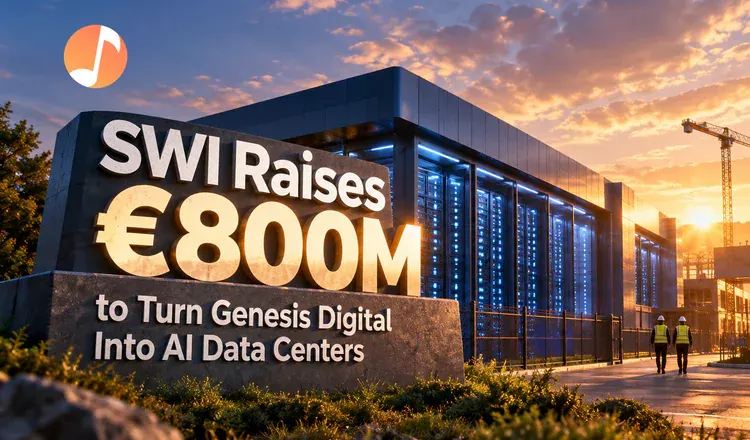
SWI Group raised 800 million euros from institutional investors and intends to point the former Genesis Digital mining estate at artificial-intelligence workloads. The announcement went out at midnight New York time on Monday, datelined Singapore and Amsterdam, and puts a final valuation of 6.1 billion euros on the group. Genesis Digital came out of the FTX bankruptcy estate. Its US and Swedish sites are being marketed to hyperscale cloud providers, the operators that rent out compute at scale, while its Kazakh mining sites are being sold. The release announcing all of this never uses the words bitcoin mining.
The dollar figure nobody agrees on
The euro number is common to every account and to the company. The conversion is not. CoinDesk gives the raise as $894 million, while the photo caption on that same page says roughly $930 million. Blockhead, filing in the afternoon, calls it about $900 million. Three dollar figures for one euro amount, with one outlet contradicting itself inside a single page, and none of the three names the rate it used. They do not reconcile. SWI says the money arrives as new ordinary shares issued in several series, lifting total share capital to 558,399,385 shares, with options for certain investors tied to equity-capital-market milestones. No investor is named anywhere.
How much of the miner, and when
The two accounts of the purchase do not line up either. CoinDesk has SWI buying about 40% of Genesis Digital in June for $500 million, completing in August, and holding 70% of the voting rights, a figure only CoinDesk carries. Blockhead has the same $500 million buying about 38.3% of the shares and closing on 15 June, the day the FTX estate dropped its clawback suit against the miner, with majority ownership reached later. The stake size and the closing date differ between the two tellings. Both agree SWI controls the company now. Alameda Research had put money into Genesis Digital from 2021 for a holding of about 20%: more than $1 billion on CoinDesk's reading of Wall Street Journal reporting, about $1.15 billion on Blockhead's.
What the sites are worth as compute
Power is the asset here, not the machines. Blockhead counts more than 1.3 gigawatts of energized and approved grid connections across 15 Genesis Digital facilities, plus 2.3 gigawatts at AiOnX, SWI's European platform, for a combined total above 3.6 gigawatts. Those are one outlet's figures, and the company's own release carries no capacity number at all. The American estate sits in Texas, North Carolina and South Carolina, with Sweden alongside it. Three small Kazakh mining sites are on the block, and no buyer or price has been reported for them. Administrators of the FTX estate were quoted in one account describing the Kazakh assets as virtually worthless.
"Power connectivity is the most valuable commodity in digital infrastructure today," Max-Hervé George said when the Genesis Digital stake closed.
A conversion that has stopped being news
Miners have spent most of this year selling their power rather than their hashrate. IREN crossed the line inside its own accounts when AI cloud revenue overtook mining, and the exits show up in the network itself, with hashrate down more than 20% as operators repoint capacity. George, SWI's founder and chief executive, told the Wall Street Journal he has zero interest in bitcoin mining. What nobody has reported is a signed hyperscaler tenant for any of these halls. Grid connections and approvals are not the same thing as racked, cooled and leased compute, and the gap between them is measured in years. Until a tenant is named, the raise has bought optionality on power.
Read also: Luxor Puts September's Hashrate Forward Spread at 6% to 13% in BTC