
Broadcom, Verizon and Seven More Object to OKXICE Stock Tokens
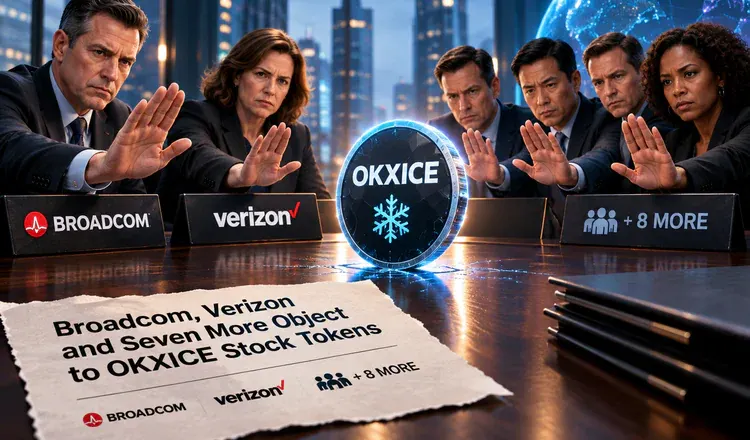
Nine US-listed companies have told OKXICE it may not put their shares on chain. The objections appear in a public notice the venue published on Thursday, and they are the first visible test of a consent right the SEC wrote into its tokenized-stock order last month. The nine are Cerebras Systems, AppLovin, Applied Digital, Rocket Lab, CoreWeave, Verizon, Applied Optoelectronics, Broadcom and UnitedHealth Group. The notice gives no reasons. A timely objection bars that venue from listing the token, so those nine tickers are out of its pools.
Only one objector has said why
Applied Optoelectronics is the only one of the nine to have explained itself, and it did so to The Wall Street Journal, which broke the story. The Block, carrying that reporting on Saturday, has the company saying it saw no clear benefit for shareholders and worried about investor confusion over an offering it had not sponsored.
Applied Optoelectronics told the Journal it was "unsure how tokenization would affect its stock price, liquidity and volatility."
The other eight have said nothing in public. Neither OKXICE nor any of the nine answered The Block's requests for comment. Objecting to one venue is not the same as rejecting tokenization, Securitize president Brett Redfearn told the Journal, and his firm, which opened trading in 12 tokenized US stocks on 8 October, is expected to trade on OKXICE itself.
Thirty days, one venue at a time
The mechanics come from the five-year exemption the SEC issued on 17 September, which lets a tokenized securities venue trade tokenized versions of listed stocks without registering as an exchange. A venue tokenizing a third party's shares has to send written notice to the company and wait at least 30 calendar days. Nasdaq's guidance for the companies it lists, read on Sunday, puts the issuer's side plainly: 30 calendar days to evaluate the proposal and file an objection, after which silence lets the venue proceed. Objections go to the venue that sent the notice; Nasdaq cannot file them for an issuer.
The scope is narrow by design. An opt-out binds only the venue that issued the notice, and the exemption offers no blanket version, so every new venue restarts the clock. OKXICE told the SEC of its plans on 4 October and named 63 tickers; eight of the nine objectors were on that list, and Cerebras was not. That detail sits in The Block's account alone.
Nasdaq is keeping its own stock off
Nasdaq has said it will opt NDAQ out of these venues while describing itself as committed to tokenization, and its guidance argues that issuers should stay at the center of how their equities are tokenized. A spokesperson gave the Journal the reason: the exchange does not want its stock on a venue that does not display best prices in real time or report to the consolidated tape. That is a market-structure complaint, not a crypto one.
What the venue still intends to launch
OKXICE has set no launch date. It told the Journal it still plans dozens of US-listed stocks, naming Nvidia, Apple and Tesla among them. None of those has objected publicly. Trading would run through permissioned liquidity pools on X Layer, OKX's layer-2 network, each stock paired against USDC, USDG or USDT. Traders clear identity and sanctions screening before they get in. Bitcoin.com News, filing at 04:30 UTC on Sunday, adds that an independent third party would hold the shares and that each token would carry one share's dividend and voting rights. The Block does not carry those details, and neither contradicts the other.
Scale is what the objections push against. Tokenized stocks stood at about $3.5 billion on 15 October by The Block's own count, against roughly $680 million at the start of the year. Morgan Stanley has said it expects to support tokenized equities in the first quarter of 2027. Nine refusals is a small share of a 63-name list. It is also the first use of the consent right since the order took effect, and what settles next is whether the rest of that list stays quiet before the 4 October clock runs out.
Read also: Robinhood Refuses AMC's Demand to Pull Its AMC Stock Token