
Securitize Debuts on the NYSE After a $400M SPAC Merger
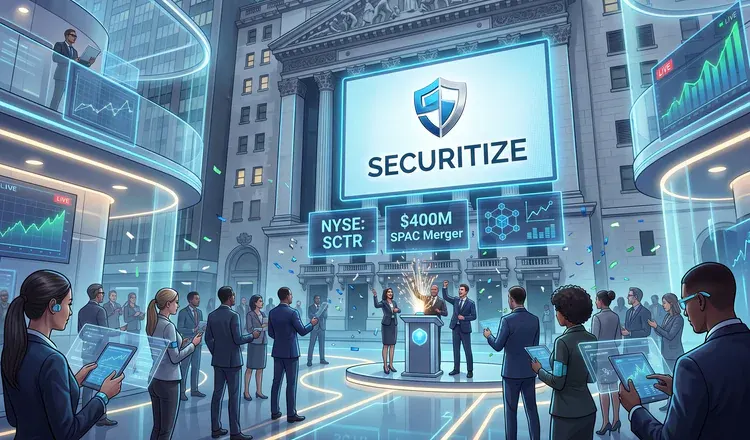
Securitize began trading on the New York Stock Exchange on July 2 under the ticker SECZ, a day after closing its merger with Cantor Equity Partners II. The route was a SPAC merger, in which a private company combines with an already-listed shell holding cash raised from investors and so reaches the public market without a conventional initial public offering. The deal raised approximately $400 million in total against a pre-money valuation of $1.25 billion. That figure includes an oversubscribed $225 million PIPE, a private placement agreed alongside the merger to top up the cash the shell brings. Securitize builds and administers tokenized funds, investment vehicles whose shares are issued and recorded on a blockchain, and acts as transfer agent, the regulated role that keeps the official register of who owns what. It also tokenized its own stock on listing day.
A trust that held 71.5%
The clearest measure of how a SPAC deal is received is how much of the shell's trust account survives to closing, because shareholders in the shell can redeem their shares for cash instead of taking stock in the merged company. Securitize retained about 71.5 percent of the trust. Redemptions ran under 30 percent. That is a comparatively low figure for a listing of this kind, and the oversubscribed $225 million PIPE did the rest of the work, bringing combined proceeds to roughly $400 million. The merger with Cantor Equity Partners II closed on July 1 and trading opened the following day.
The register behind the tokens
Securitize occupies a narrow but structural position in tokenization. It issues fund shares on-chain and keeps the transfer-agency records that make those shares legally recognizable holdings rather than tokens with no registry behind them. It has issued approximately $4.4 billion in tokenized assets to date, and it administers BlackRock's BUIDL, the tokenized fund that has grown past $3 billion. The named institutional partners and clients include BlackRock, Apollo, KKR, Hamilton Lane, VanEck and BNY Mellon. That roster is why a listing of this size draws attention beyond its own market capitalization: the firm sits behind a large share of the tokenized funds being brought to market by large asset managers, and its disclosures as a public company will make parts of that activity visible for the first time.
An issuer as its own first client
Reporting on the debut described Securitize as the first issuer to tokenize its own stock on day one of a listing. In practice it means an on-chain representation of SECZ shares exists alongside the ordinary listed line from the outset, not added later as a separate project. Price is still set on the NYSE. The exercise is a demonstration, not a change in how the shares trade, but it does put the company in the position of running its own equity through the infrastructure it sells to clients.
Public reporting for a private-market plumbing business
The immediate consequence of the listing is disclosure. Tokenization has so far been measured mostly through on-chain balances and issuer announcements, and a public filer that administers a meaningful share of those assets will have to report revenue, costs and concentration on a schedule. That will also test how the market values infrastructure as opposed to tokens, at a point when traditional asset managers have been assembling dedicated crypto divisions and may build competing capability in-house. Whether the retained trust and the PIPE prove sufficient depends on how quickly the pipeline of tokenized funds converts into recurring administration fees. None of that is visible yet.
Read also: Citadel Securities Takes a $400M Stake in Crypto.com at $20B