
What Is VWAP and How to Use It in Practice?
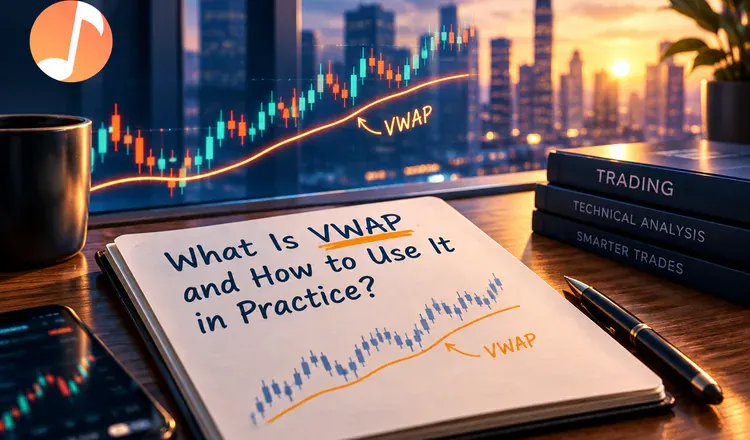
VWAP stands for volume weighted average price. It is the average price that everyone trading today actually paid, with larger trades counting for more than small ones. A plain average treats a $50 buy and a $5 million buy as equals. VWAP does not. On a Bitcoin chart it draws a single line that answers one question: so far today, where did the real money change hands?
Why weighting by volume changes the answer
Picture a cafe. In the morning rush it sells 900 coffees at $3. In the quiet afternoon it raises the price and sells 20 at $5. Average the two prices and you get $4 - a number no customer ever paid. Weight each price by how many cups sold at it and you get about $3.04, which is much closer to the truth of the day. VWAP does exactly that to a trading session, cup by cup.
Why the line resets
VWAP is a session tool. It starts fresh at the open and accumulates through the day, which is why it swings around in the first hour and barely moves by the end - each new trade is a smaller slice of a growing total. Crypto never closes, so there is no natural open. Most charts settle on 00:00 UTC as the reset for coins like Bitcoin and Ethereum. That is a convention your charting software chose, not a property of the market, and it is worth knowing which one yours uses.
How traders actually use it
- As a benchmark. This is the original job. A desk filling a large order judges itself against VWAP: buying below the day's volume weighted average price means it did better than the average participant.
- As a bias line. Many intraday traders simply treat holding above a rising VWAP as constructive and slipping below it as a reason to stand down.
- As a stretch gauge. Price far from VWAP has travelled a long way from where the volume is, and often drifts back toward it.
One practical warning: VWAP is built for one session. On a weekly chart it tells you almost nothing, because the session has barely begun. If you want a volume weighted average measured from a specific event - a listing, a crash, an all-time high - that is a different tool, the anchored version covered in volume profile and AVWAP. Before you trade off any of it, spend a week just watching the line on a chart you know well, and read what crypto volume actually measures first.