
What Is ERC-1155? One Contract for Many Kinds of Token
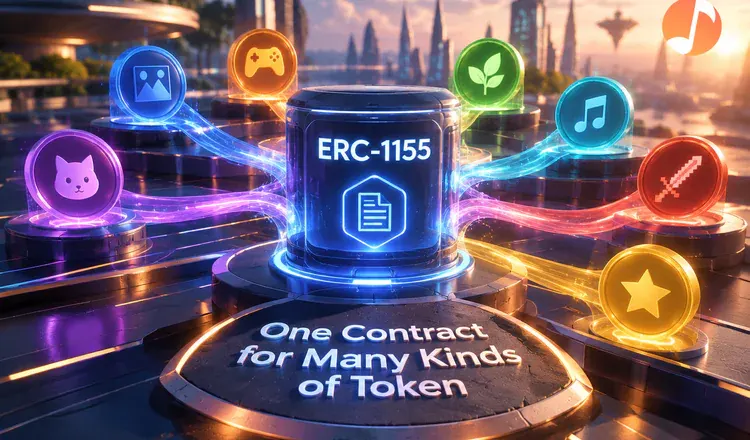
ERC-1155 lets a single Ethereum contract issue many different token types at once. Some of those types can be interchangeable, like a stack of identical potions, and others unique, like a single named sword - and you can send several of them to someone in one transaction. It came out of the games studio Enjin in 2018 and became an official standard the following year.
Why would anyone need this?
Imagine a shop that had to register a separate company for every product on its shelves. That is roughly what came before: an ERC-20 contract for each interchangeable item and an ERC-721 contract for each collection of unique ones. A game with five hundred items meant five hundred deployments to pay for and keep track of. ERC-1155 replaces them with one contract holding an inventory - item 1 is a potion with a supply of ten thousand, item 2 is a sword with a supply of one.
How is ERC-1155 different from ERC-721?
Two ways that matter. First, every token ID carries a quantity rather than a single owner, so the same contract can describe both "one of these exists" and "a million of these exist". Second, transfers come in batches: sending a player ten potions, two shields and one sword is one transaction and one fee, instead of four. On a busy day that difference is the price of a coffee rather than a rounding error.
Where you will run into it
Game and metaverse items are the obvious home, but it also shows up in multi-edition collectibles, event passes and marketplace storefronts where many creators mint under one shared contract. OpenSea has used it for exactly that.
If your wallet shows a quantity next to something you thought of as an NFT, you are probably looking at an ERC-1155 token - check the contract on a block explorer before moving it, because a few older tools and bridges still only handle ERC-721. Side by side with its neighbours in ERC-20 vs ERC-721 vs ERC-1155, and the unique-item standard itself in what ERC-721 is.