
Real-Time Crypto Wallet Monitoring
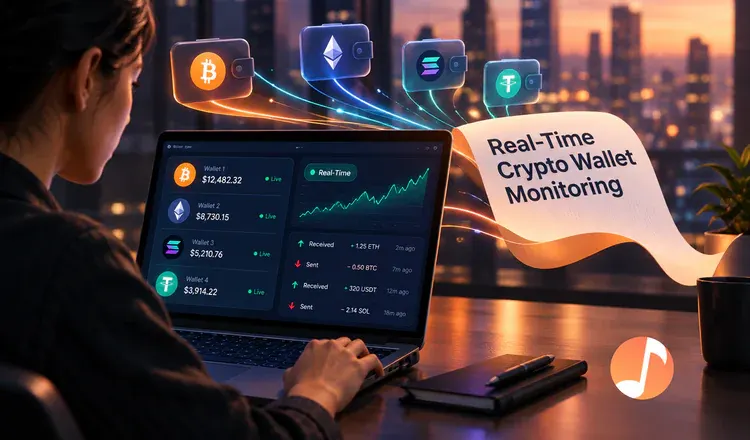
Real-time crypto wallet monitoring means watching a public address and being told the moment it moves money, instead of checking by hand. You need nothing private to do it - every wallet's history is public, so the address alone is enough. People use it two ways: to follow large holders, and to get an instant warning if their own wallet is ever drained.
What does "real time" actually mean here?
As fast as the blockchain underneath, and no faster. Solana confirms in under a second, Ethereum adds a block roughly every twelve seconds, Bitcoin takes about ten minutes on average. Some tools also show transactions still waiting in the queue, which is earlier but less certain, because a waiting transaction can still be replaced or dropped. In practice an alert reaches you seconds to a couple of minutes after the move - early enough to understand what happened, never early enough to get in front of it.
How do you set it up?
The free version takes about two minutes. Make an account on Etherscan, open the watch list, paste the address, tick "notify on any activity" and you get an email every time it moves; Solscan and BscScan have the same feature for their chains. Portfolio trackers like DeBank and Zerion let you follow a wallet and see its balances change instead of raw transactions. Telegram bots push the same alerts to your phone, which is the version most people stick with.
Watching your own wallet, not just whales
This is the use worth setting up today. Put your own MetaMask or Ledger address on a watch list, and an unexpected outgoing transfer reaches you within a minute or two rather than next time you log in. That will not stop a theft, but minutes matter: you can cancel token approvals and move whatever is left in a second wallet.
One hard rule while you set this up: monitoring only ever needs a public address. Any tool that asks for your seed phrase or private key to "watch" a wallet is stealing it. For the tracker options side by side, see the best whale trackers and alerts, or how to track whale movements step by step.