
Leverage Effect Explained, With Formula and Example
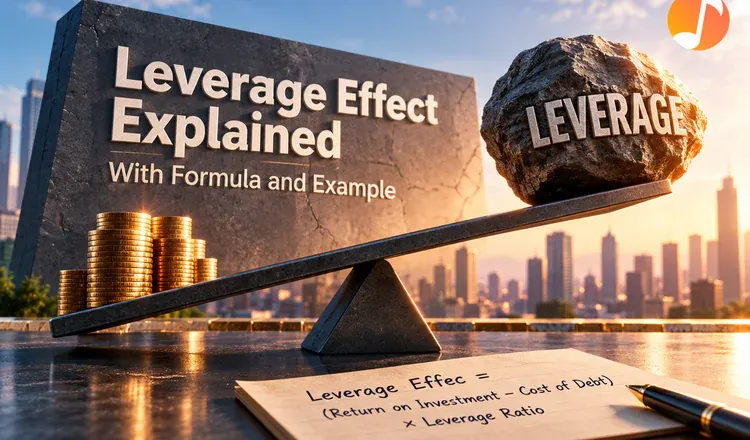
The leverage effect is what happens to your money when you trade with borrowed size: the percentage move of the coin is multiplied before it reaches your account. Put up $100 at 10x and you control a $1,000 position, so a 1% move in Bitcoin becomes a 10% move in your balance - in whichever direction it goes. That multiplication, up and down, is the whole of the leverage effect.
What is the formula?
Two lines of arithmetic cover it. Position size equals your margin multiplied by the leverage: $100 at 10x is a $1,000 position. Your result equals the price move in percent multiplied by the leverage: a 3% rise at 10x is +30% on your $100, and a 3% fall is -30%. Nothing else in leverage trading is harder than this; everything else is a consequence of it.
A worked example
You open a $200 margin position on Ethereum at 5x, so the position is $1,000. Ethereum rises 4%: the position gains $40, which is 20% of your $200. Now run it the other way. Ethereum falls 4%: you are down $40, or 20%, with $160 of margin left. Fall 20% and the $200 is gone - the exchange closes the position before your loss can reach the lender's money, which is called liquidation. A useful rough rule: divide 100 by the leverage and that is roughly the percentage move against you that wipes out the margin. At 10x it is about 10%, at 50x about 2%, and fees and funding costs make it arrive slightly sooner.
Why does it feel different from the maths?
Think of leverage as a longer spanner on the same bolt. The same effort moves far more, and the same slip strips the thread. Crypto routinely moves 5% in a quiet afternoon, so a multiple that looks modest on paper puts the liquidation price inside normal daily noise. The exchange also charges fees and funding on the full $1,000, not on your $200, which quietly drains margin while you wait to be right.
Before opening anything, write down the liquidation price and ask whether an ordinary day could reach it. If the answer is yes, the leverage is too high, no matter how good the idea looks. Next: what leverage actually is and how much leverage is too much.