
How to Spot Fake Breakouts in Crypto: A 3-Step Guide
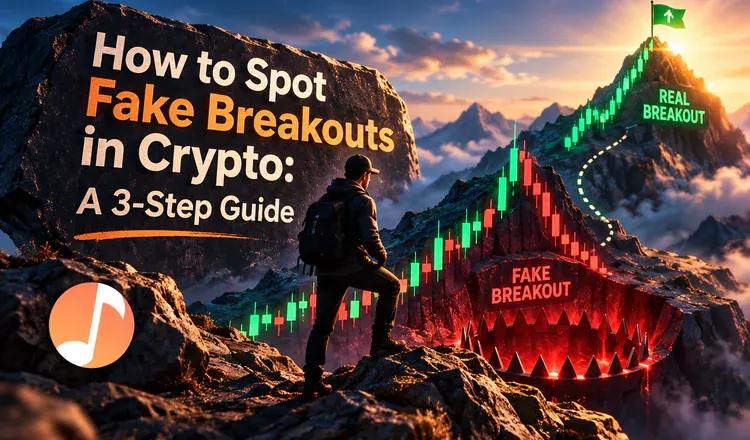
Spotting a fake breakout in crypto comes down to three checks, run in order: did a candle close beyond the level, did volume confirm it, and did the level hold when price came back to test it. A move that passes all three is usually real. A move that fails any one of them is better left alone, whatever everyone else is saying about it.
Step 1: wait for the close, not the wick
A wick through a level means price visited; a close beyond it means price stayed. Those are very different pieces of news, and only the second one costs the other side money. Pick the timeframe you actually trade - for most people the 1-hour or 4-hour candle on Bitcoin or ETH - and refuse to act until that candle is finished. This single rule removes the majority of fakeouts, at the price of entering a little later on the real ones.
Step 2: check the volume behind the move
Open the volume bars under the chart and compare the breakout candle with the ten or twenty before it. A real break out of a range needs new participants, and new participants show up as a bar that is clearly taller than its neighbours. A break on ordinary volume is usually just the orders that were already sitting there being triggered - no one new has arrived, so there is nobody to keep the move going.
Step 3: let the level prove itself
After a true breakout price very often comes back to the level it broke and uses it the other way round: the old ceiling becomes support, the old floor becomes resistance. Watch that retest instead of the break. If the level holds, you have both confirmation and a sensible entry with your invalidation point only just below. If price slips back through and closes inside the range, the breakout has failed and the range is still in charge.
Try the three steps on past charts before using them live - scroll back, find the obvious range breaks on any major coin, and check which ones passed all three. Then read what a fakeout is for the reason the traps form, and avoiding false breakouts and false breakdowns for the downside version.