
Avoiding False Breakouts and False Breakdowns
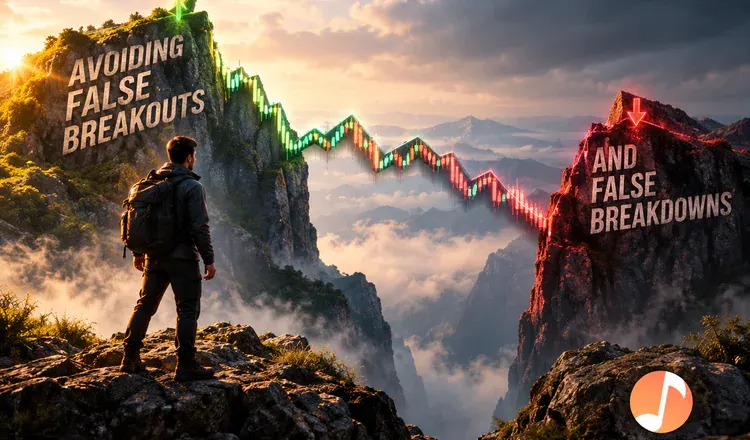
A false breakout is a move above resistance that fails. A false breakdown is the same thing below support. They are mirror images, and avoiding false breakouts and false breakdowns comes down to one discipline: treat the first touch of an obvious level as a question, never an answer. The downside version catches more people, because fear acts faster than greed.
Why false breakdowns bite harder
When price slices below a floor that has held for weeks, selling stops being a decision and becomes a reflex - and often an automatic one, since that is exactly where protective stop orders sit. The candle fills those sells, runs out of supply, and turns. In crypto there is an extra push: traders using borrowed money get closed out automatically as price falls, which adds selling that has nothing to do with anyone's opinion. That is why breakdowns can overshoot further than breakouts and snap back faster.
The habits that avoid both
- One closed candle. Whatever timeframe you trade, let the candle finish beyond the level before you believe it, in either direction.
- Keep your stop off the round number. If your exit sits where every chart drawing tool puts the line, it sits in the pool that gets swept. Give it room and reduce your position to keep the risk the same.
- Watch the reaction, not the break. A level reclaimed within a couple of candles tells you more than the break did - and often marks the start of the real move in the opposite direction.
What to do when one catches you
Take the loss at the level you chose in advance, and resist widening it, because a failed break rarely returns politely. Then wait. The strong temptation is to flip immediately at the same size, and that is how a small loss becomes the day's largest. The reversal after a sweep can be a good trade, but it is a new one, with its own entry and its own invalidation point.
A practical start: mark your levels before the session, not during it, so you are judging a plan instead of a candle. For the real-versus-fake checklist see breakout vs fakeout, and for a pattern that fails the same way, when a symmetrical triangle fails.