
How to Protect Your ENS Name With Different Roles
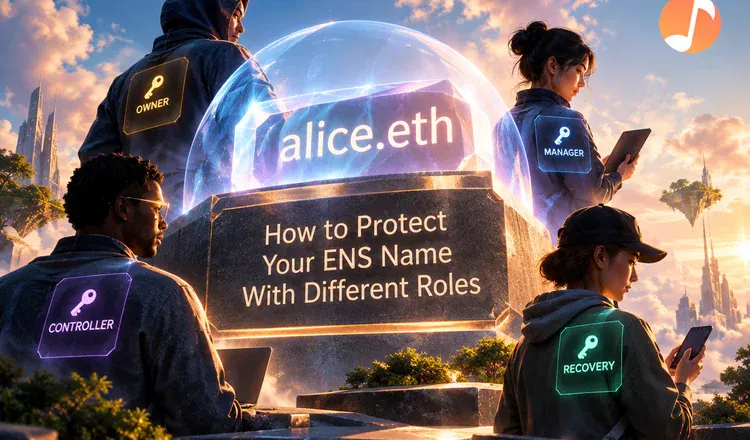
An ENS name does not have to sit under a single wallet. An ordinary unwrapped .eth name has an Owner, which holds the name and is the only role that can transfer it, and a Manager, which can edit the name's records and create subnames but cannot move the name itself. Separately there is the ETH address record - the wallet that payments sent to the name actually land in. Each can point at a different address, and that split is the protection.
What each role is allowed to do
Think of a company car. The Owner holds the title deed. The Manager has the keys and can retune the radio - records, subnames - but cannot sell the vehicle. The ETH address record is simply where the car is parked, which is to say where the money goes. The permissions follow from that: the Manager can update the ETH record, the Owner or the current Manager can change the Manager, and only the Owner can change the Owner, because changing that address transfers the name's NFT to whoever receives it.
How to split them in practice
The usual setup puts the Owner on a hardware wallet - a Ledger or Trezor that stays offline - and leaves the Manager on the MetaMask wallet you browse with. Daily record edits carry on as normal from the hot wallet, but a drainer that catches that wallet can only vandalise records; the name itself does not move. Each address change is its own transaction, and ENS suggests doing them in the order ETH record, then Manager, then Owner, so you never hand away ownership before the rest is in place.
Two things to check first
Names wrapped in the ENS Name Wrapper have no separate Manager field at all - that role is folded into the Owner on the token contract, so the split is unavailable until the name is unwrapped. Subnames work the other way round: they only ever have a Manager, never an Owner. ENSv2 also drops the single Manager role in favour of granting a wallet only the specific permissions it needs, so expect the buttons to move.
If the name is worth anything to you, do the one-transaction version today: move the Owner to a hardware wallet and leave the Manager where it is. Then read the other ways a name gets taken and how lookalike names work.