
How Governments Deanonymize Crypto Transactions
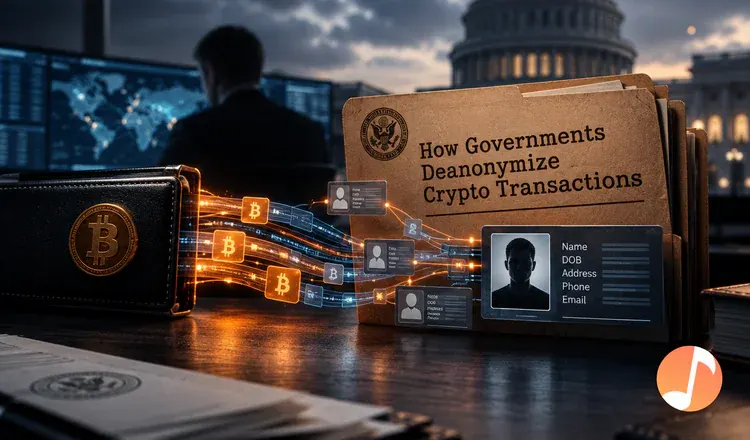
Tax authorities, police forces and financial regulators do not have a special key to the blockchain. They read the same public ledger as everyone else. What they have is three things an ordinary observer does not: forensic software that organises the ledger, the legal power to ask companies for customer records, and the patience to wait for the two to meet.
Step one: buy the map
Agencies license analysis tools from private firms - Chainalysis, Elliptic and TRM Labs are the names that come up most - rather than building their own. These products group addresses that behave like one wallet and label the big ones: this cluster is an exchange's deposit system, that one is a mining pool. An investigator types in a single address and gets back a diagram of where the money came from and where it went.
Step two: ask the company that knows the customer
The map ends wherever the coins meet a regulated business. Exchanges and brokers are required to verify who their customers are, so they hold the name, the documents and often the bank account behind an address. A court order or a formal request turns that into evidence. The same duty applies to many payment processors and custodians, which is why "the coins went to an exchange" is usually the end of the trail rather than the middle.
Step three: wait
Coins that never touch a regulated service are harder to attribute, but the ledger does not forget. Funds can sit untouched for years and still be followed the moment they move, which is why large thefts are often resolved long after the event - the stolen Bitfinex bitcoin, taken in 2016, was traced and seized in 2022.
Nothing here requires wrongdoing to apply to you: the same pipeline is what lets a tax office match an exchange record to a wallet. The practical note is simply to keep your own records - dates, amounts, which exchange - because the chain will remember them whether or not you do. For how the grouping works underneath, see how Chainalysis tracks wallet addresses and de-anonymizing Bitcoin.