
How Does Bitcoin Mining Work? A Simple Explanation
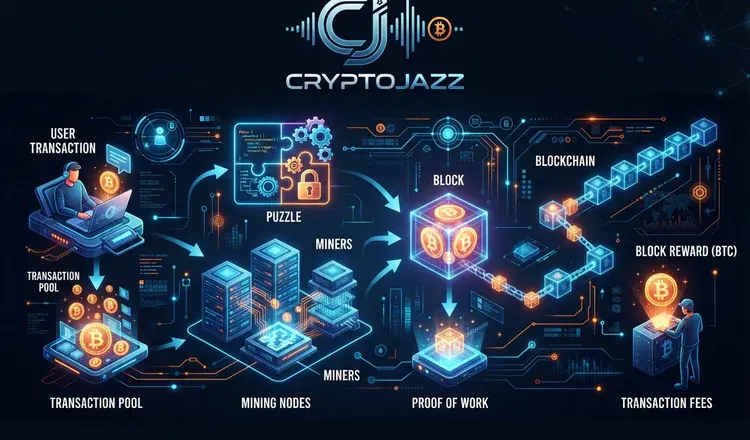
Bitcoin mining is how new coins are created and how payments get confirmed, and underneath it is a guessing contest. All over the world, specialized computers race to guess a number that seals the latest batch of transactions. The winner adds that block to the shared record and collects a reward: right now 3.125 new bitcoin plus the fees from the transactions inside. A new winner turns up about every ten minutes.
What are the machines actually doing?
Guessing, trillions of times a second. Each one takes the pending transactions plus a number of its own choosing, runs them through a fixed mathematical recipe, and checks whether the answer starts with enough zeros. There is no shortcut; the only way to find a winning number is to try numbers. That is why mining burns electricity, and why it behaves like a lottery where buying more tickets is the only strategy. Every two weeks the network measures how fast blocks are arriving and adjusts how many zeros are needed, so that however many machines join or quit, a block still lands roughly every ten minutes.
Why go to all that trouble?
Because the expense is the security. To undo a past payment, an attacker would have to redo that block's work and every block built on top of it, faster than the rest of the world combined. That is enormously costly, and it gets costlier with every new block, which is why shops wait for a few confirmations before treating a payment as final. The reward also shrinks on a schedule: it halves roughly every four years, from 50 coins in 2009 to 3.125 today, with the next cut due in 2028, and that is how issuance eventually stops at 21 million.
Can you mine at home?
Not on a laptop. Home computers were competitive in 2010; today the work is done by purpose-built machines called ASICs, most of them racked in warehouses next to cheap power. Small miners join pools, where thousands of machines combine their guessing and split the rewards in proportion. And not every crypto is mined at all: Ethereum stopped mining in 2022 and now uses staking, which does the same job with deposits instead of electricity.
If mining tempts you, price your electricity before you price the hardware, and be very wary of "cloud mining" sites selling contracts for machines you never see, because that corner of the industry is thick with scams. For most people, buying bitcoin and moving it to a wallet they control is simpler and cheaper than trying to mine it. Read next: how the blockchain ledger works.