
What Is Bitcoin? The 15-Second Explanation
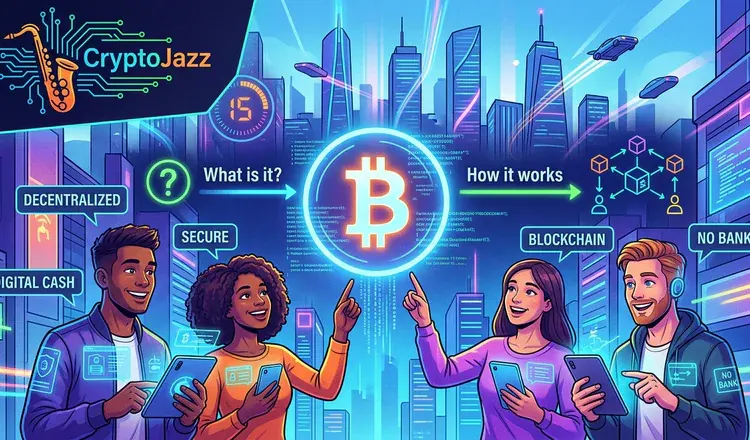
Bitcoin is digital money with a fixed supply that anyone can send to anyone, without a bank. The 15-second version: it is a public list of every payment ever made, kept by thousands of independent computers, and new coins are handed out to whoever helps keep that list honest, until 21 million exist and issuance stops for good.
The same thing, slowly
Think of bitcoin as gold that travels like an email. Gold is valuable partly because it is hard to dig up and impossible to fake. Bitcoin is scarce because the software says so, and impossible to fake because every copy of the record would reject a coin that was never issued. Unlike gold, it crosses the world in minutes, and unlike a bank transfer, it does not stop for weekends.
Why can't someone just copy a bitcoin?
Because a bitcoin is not a file on your computer. It is an entry on the shared record, and copying that entry does nothing, in the same way photographing a bank statement does not give you the money. To spend a coin you have to sign with a private key that only you hold, and the network accepts that payment only once. Roughly every ten minutes the pending payments are bundled into a block and locked in behind the ones before it.
How do people hold it?
Most buy on an exchange and then move the coins to a wallet they control: an app such as MetaMask for small amounts, a hardware device such as a Ledger for larger ones. You do not need a whole coin either. Bitcoin divides into 100 million pieces called satoshis, so buying twenty dollars' worth is completely normal.
The habit worth building first: write your recovery phrase on paper, store it somewhere only you can reach, and never keep it as a photo or a note on your phone. Send a small test amount before any real transfer. For the wider picture, read what crypto is, or see how the shared ledger keeps score.