
S&P's Vault Risk Grades Go Onchain Through Chainlink on Base
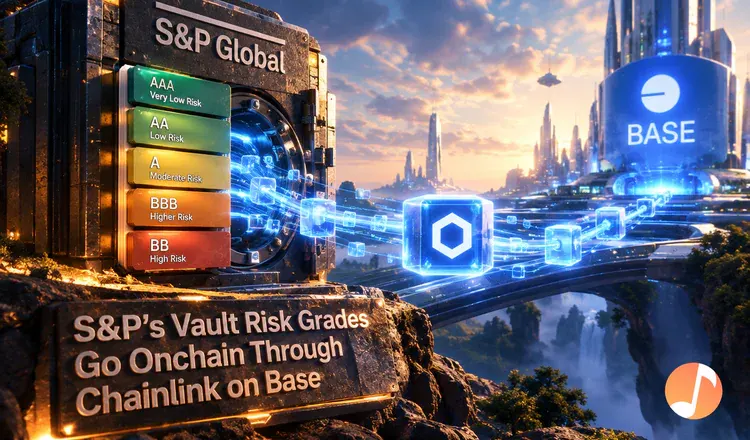
Chainlink started publishing S&P Global Ratings' vault risk opinions onchain on Wednesday, with Base the first network to carry them. The data comes from the Vault Risk Assessment, a framework S&P launched on 4 October that scores how likely an investor's position in an onchain lending vault is to be impaired. A vault here is a pool of deposits run by a curator, the party that decides which loans the money funds and against what collateral. S&P puts deposits in such vaults at about $10 billion in September, against roughly $1.5 billion two years earlier. What no account read here names is a single vault that has actually been graded.
What a vault risk grade measures
The assessment is an opinion on relative impairment risk. It is not a credit rating, and S&P says it does not address the yield a vault pays. Wednesday's announcement lists six inputs:
- portfolio credit quality
- liquidity mismatch
- curator risk
- blockchain risk
- protocol risk
- vault security and governance
Grades use the agency's familiar letter symbols with a "(v)" suffix attached, and crypto.news reported at the launch three weeks ago that AAA(v) is the lowest-risk step and that S&P warns the letter is not a guarantee against loss. That outlet is the only one read here that gives the scale at all. It also quoted two S&P executives on the day, president Yann Le Pallec on demand for independent assessment and ratings-services head James Wiemken on how far vault disclosure standards vary. Neither spoke to this week's distribution arrangement.
Base first, and the pipe that carries it
The assessments travel through Chainlink DataLink, a data publishing service aimed at institutions, and the Chainlink Runtime Environment, which handles fetching S&P's values and writing them to a chain. A decentralised oracle network retrieves the source figures, agrees on them and delivers them onchain. Base is the only network named. The announcement, issued at 09:00 in New York, gives no second chain, no timetable for one and no commercial terms. This is the second S&P product to make the trip: the agency's stablecoin stability assessments went onchain through Chainlink under a deal dated 14 October last year, a year in which S&P also bought the contract-audit firm OpenZeppelin.
"Every great financial market has been built on secure data, and onchain finance is no different," Johann Eid, chief business officer at Chainlink Labs, said in the announcement.
No graded vault to point at
A framework is not a grade. When S&P introduced the assessment on 4 October, no individual vault had received one, and the agency named neither the vaults nor the curators it would review first. Wednesday's announcement describes the onchain feed as live and names no vault carrying a score. Investing.com and Finadium, the two independent accounts read here, name none either. No letter has surfaced yet. We could not establish whether any assessment had been published at the time of writing. A lender choosing where to put money can read the methodology today; what that lender cannot yet read, on the evidence available, is a letter beside a vault in use. Institutions have been borrowing in these venues all year, including through the facility that lets firms borrow USDC against bitcoin through Morpho.
What the deposits did without any grades
The climb from about $1.5 billion to about $10 billion happened with no agency opinion attached to any of it. That is the condition S&P is selling into, and it is also the reason the pitch is hard to test. Curators compete on yield and on reputation, and a letter only bites if depositors move money when it changes. That has not been shown. Nothing in the material read here shows it happening yet. The next concrete things to watch are a named vault with a published assessment, a curator citing one in its own disclosures, and a second chain behind Base.
Read also: Chainlink's CCIP 2.0 Lets Apps Add Their Own Cross-Chain Verifiers